#359: Dr. Kim Williams Breaks Down the New Heart Health Guidelines (and it's Great News for Plants!)

The newest AHA and ACC guidelines for treating dyslipidemia are here — and according to Dr. Kim Williams, they mark a powerful shift toward prevention, earlier testing, and whole-food, plant-based nutrition as the foundation of cardiovascular care.
Rip welcomes back Dr. Kim Williams, past president of the American College of Cardiology, for a practical and deeply encouraging breakdown of what these updated cholesterol guidelines mean for everyday people.
Dr. Williams explains why cardiovascular risk is no longer just about one cholesterol number. Instead, clinicians are being encouraged to look at the whole picture: LDL cholesterol, ApoB, Lp(a), inflammation, blood pressure, blood sugar, kidney function, family history, lifestyle, and coronary artery calcium when appropriate.
The most exciting part for the PlantStrong community? Lifestyle optimization is now treated as the clinical foundation — and Dr. Williams is clear about what that means: a whole-food, plant-based diet built around beans, grains, nuts, seeds, fruits, vegetables, and mushrooms, along with exercise, sleep, mindfulness, strong social connections, and avoidance of tobacco, alcohol, and other harmful substances.
This conversation also tackles statins, PCSK9 inhibitors, Lp(a), coronary calcium scoring, and the new philosophy of treating risk lower, earlier, and longer — always with food first, and medication when needed.
Key Takeaways
The new cholesterol guidelines emphasize lifestyle first, not lifestyle as an afterthought.
Dr. Williams says a whole-food, plant-based diet should be built around beans, grains, nuts, seeds, fruits, vegetables, and mushrooms.
LDL cholesterol is still important, but it is no longer the only number that matters.
ApoB may give a clearer picture of risk in some people, especially those with diabetes, high triglycerides, or central obesity.
Lp(a) is largely genetic and should be measured at least once in adulthood; the 2026 guideline includes updated recommendations for elevated Lp(a).
Coronary artery calcium scoring can help personalize risk and guide LDL targets.
Dr. Williams emphasizes that the goal is not “plants versus statins.” It is whole plant foods first, medications when needed.
The overall prevention philosophy is: lower, earlier, longer.
Episode Resources
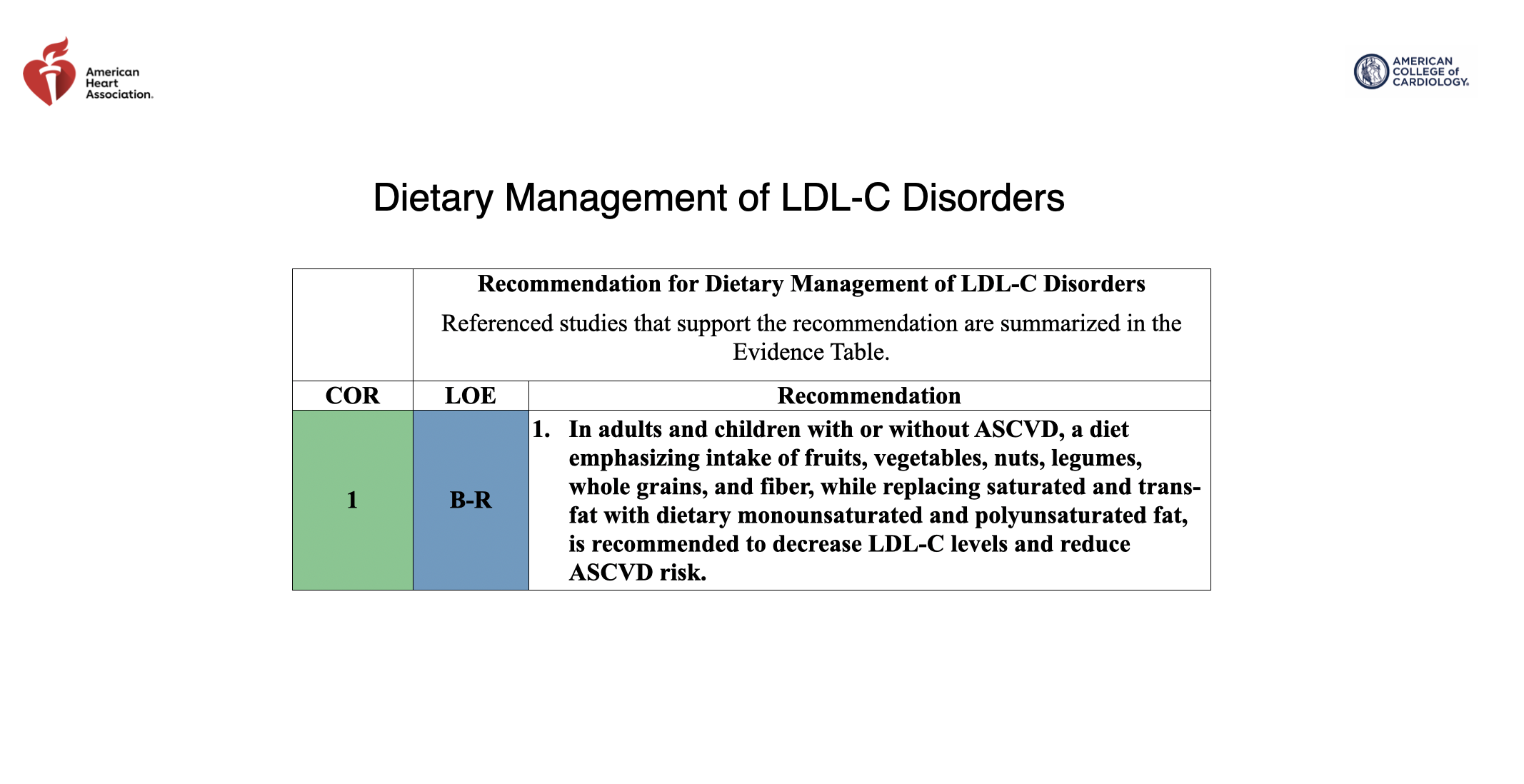
A whole foods, plant-based diet is recommended for heart health
Watch the episode on YouTube: https://youtu.be/6cD8tGpsAgg
Read more about the guidelines: https://professional.heart.org/en/science-news/2026-guideline-on-the-management-of-dyslipidemia
We hope to see YOU at one of our 2026 Live Events! https://plantstrong.com/pages/events Use code: podcast to receive early bird pricing
To stock up on the best-tasting, most convenient, 100% PLANTSTRONG foods, check out all of our PLANTSTRONG products: https://plantstrong.com/ Use code: plantstrong10 to receive 10% off your first order.
Plant Strong Meal Planner: https://mealplanner.plantstrong.com/
Give us a like on the PLANTSTRONG Facebook Page and check out what being PLANTSTRONG is all about. We always keep it stocked full of new content and updates, tips for healthy living, and delicious recipes, and you can even catch me LIVE on there!
We’ve also got an Instagram! Check us out and share your favorite PLANTSTRONG products and why you love it! Don’t forget to tag us using #goplantstrong 🌱💪
Episode Transcript via AI Transcription Service
I'm Rip Esselstyn, and you're listening to the Plant Strong Podcast.
[0:06] I don't need to tell you that there is a lot of conflicting health advice that's out there, and sadly, a lot of it comes from so-called experts. We're bombarded with messaging on what we should or shouldn't eat for optimal health, and even the latest food pyramid from the FDA added to this overwhelming confusion.
[0:30] Just recently, the American Heart Association and the American College of Cardiology, released their 2026 guidelines for the treatment of unhealthy cholesterol and blood fat levels. And guess what? They were overwhelmingly plant strong. And that's why today I am super proud to welcome back to the show Dr. Kim Williams. He is the past president of the American College of Cardiology.
[1:01] And he's here to help us unpack what the updated AHA and ACC dyslipidemia guidelines mean around LDL cholesterol, ApoB, LP little a, coronary calcium scores, statins, and long-term heart health.
Lifestyle Comes First
[1:21] What should you be doing to prevent or treat your heart health? The message is clear. Lifestyle comes first. Whole plant foods, movement, sleep, mindfulness, social connection, and avoiding harmful substances, they're not side notes. They are the foundation. So food first, plants first, prevention first. Let's hear it straight from the source, Dr. Kim Williams, right after these words from Plants Farm. And as a little side note, I want you to know that Dr. Williams was dealing with a little mini 911 emergency at the hospital. And so thank you for your patience as he was having to deal with a lot of bings and beeps and messages that were coming his way, right during the podcast interview. Okay, let's go.
[2:20] Before we indulge in today's conversation, I want to speak directly to the health care providers, clinicians, nurses, dieticians, health coaches, and medical professionals that are listening today.
[2:34] If you've learned recently about the updated cholesterol guidelines and you're thinking, yes, lifestyle comes first, but how do I actually help patients do this in the real world, then I want you to join us this year. We have two powerful opportunities for providers to go deeper with PlanStrong. The first one is our Sedona Immersion Retreat. It's September 28th through October 3rd. This is where providers can step away from, all the noise, experience the lifestyle firsthand, earn CME credits, and reconnect with the reason that you went into healthcare in the first place.
[3:13] Next, we have October 18th through the 20th. We're holding Vital Signs at Case Western Reserve University in Cleveland, Ohio. This is, again, a CME-focused conference built specifically for providers who want practical tools for bringing food as medicine, lifestyle medicine, and behavior change into real clinical care. This is where the guidelines meet implementation. This is where belief becomes practice. And this is where we're building a network of providers who understand that food, movement, sleep, stress, connection, and prevention are not side conversations. They are central to the future of healthcare. So if you want to learn more about Sedona and Vital Signs, head on over to plantstrongevents.com.
[4:09] And for everyone listening, provider or not, I want you to remember this. The easiest way to live this message is to make the next good choice easier. And this is why we created the Plant Strong Food Line. You got chilies, stews, burgers, cereals, granolas, pancakes, pizza crust kits, all made with real ingredients, no oils, no junk, and no compromise. Stock your pantry with foods that support the lifestyle that we talk about on this show week after week. You can use the code PODCAST10. Go over to plantstrong.com and save 10%. And you'll notice that we have a whole new look and feel on our website. It is so user-friendly. It is so professional. I hope you absolutely love it. Now, let's get to my conversation with the one and only Dr. Kim Williams.
[5:13] Dr. Kim Williams, I want to welcome you to the Plan Strong podcast. I should say I want to welcome you back to the Plan Strong podcast.
[5:22] Really glad to be here. And why is this guy smiling? Because we're going to follow guidelines. Absolutely. Thanks so much. Indeed. Do you know the last time that you were on the podcast was January of 2022? Wow. It was episode 125. So believe it or not, Kim, I don't think I have seen you in four years. My goodness. We were in Asheville. It seems like just yesterday. And my sister was there and everything. But I think that was 2018 or 19, believe it or not. But I mean, what's crazy to me is how fast not only time moves, but I feel like we're in an era now, with AI and information that is everything is just accelerating at a it just a very rapid pace. And I'm just trying to hang on and keep up, including these guidelines that I'd love to kind of review with you. So let's talk about these guidelines because the last time that these guidelines were, uh were basically updated were two it was 2018 so that's basically what eight years of outdated you know rules that have been guiding our our blood reports and so what i'd love to talk about with you to kind of serve up to you uh.
[6:45] Are four things for us to talk about one is like how your cardiovascular risk is calculated. Another one is what your LDL target should actually be, which tests you need
Understanding LDL Risk
[6:59] that probably haven't been offered by your doctors yet, and then when should treatment start. So let's start, Kim. Let's start with LDL. So your normal just got stricter based upon if you're low risk, intermediate risk, or high risk. Can you go over what that means and what the numbers we're supposed to shoot for are? So, Rip, very astute question. This is exactly why the risk calculators were developed. The first came out, the pool cohort equation, they call it, ASCVD risk, American College of Cardiology, American Heart Association. Just put an ASCVD into your phone and say, and you will see risk calculator come up. Everyone should take this. Next time you have a family dinner. Oh, Uncle Joe, how old are you now? 72. And what was your last blood pressure? Just estimate. And what do you think your last cholesterol was? You put those numbers in there and what along with the ethnicity and the in the old one, ethnicity is out of it now using zip codes instead.
[8:04] You you actually can tell a person what their 10 year risk of heart attack, stroke and death is. And so at that point, we were supposed to stop treating cholesterol and start treating risk. There are people with a very low blood pressure and no family history and exercising every day and their blood sugar is excellent.
[8:23] And they can tolerate a higher cholesterol than someone else who has chronic inflammation because they have lupus or rheumatoid arthritis. And so getting away from just the numbers has been extremely helpful for people. So that's what we do in the community is do that 10-year risk calculation. People said, oh, no, you're putting up a risk calculator so that more people go on statins. Well, first of all, if they read the guideline, they would see that we were talking about lifestyle change first, medication for those who need it. And importantly, we took a lot of people off of statins because of the guidelines. They had a LDL of 140. Sounds terrible, but their overall risk was 2%.
[9:08] So, we wouldn't treat that as actionable. But if it got to 7.5%, we really need to do an intervention. Lifestyle first, doing a coronary calcium score to make sure they don't have disease because that changes our LDL target. And if with a plant-based diet, they can get down to 70 and have no calcium, that's fine. If they do have calcium, we want that LDL down to 55. If they can do it with diet and exercise, great. If they can't, we do diet, exercise, and medication. Hmm. Hmm.
Beyond LDL Alone
[9:38] So do you want to talk about the numbers or are you not a fan of talking about the numbers that? Well, I mean, just so people are clear this, first of all, with the new guidelines, it really emphasizes a couple of things that people may not have heard. One is that the numbers that we're talking about aren't just LDL anymore. There are really three other numbers that everybody should know. One is the C-reactor protein, if you have any inflammatory condition. The second one is very close to LDL in terms of cholesterol particles. It's called ApoB. And if you have a very fatty triglyceride fat surrounding your LDL molecules, it's more dangerous. And ApoB actually measures that better. Okay? If a person has a really low triglyceride because they're plant-based and they're exercising all the time and they're thin, no belly fat, that kind of thing, maybe the LDL doesn't really need to be supplemented by an ApoB level. But if they're the usual American diet, diabetic, overweight, particularly central obesity, it's a real good question. You could have a normal LDL and have a very high APOB, and the LDL does not accurately reflect your risk.
[11:00] The third one is LP little A. Everyone should have that. Lipoprotein little A is a molecule that is essentially genetic and not very modifiable by diet. But if you're one of the persons who has a gene that with a higher LP little a, you are at more risk than a person, you know, having that high LDL and high blood pressure and high blood sugar, but a low LP little a, they're actually somewhat protected. Not completely, obviously. And so it's an additional risk factor that everyone should be measured once. And everyone who's high should talk to everyone in their family who's a primary relative. That's brother, sister, child. parent. Make sure that it got measured. So I understand that about, you know, the LP little a and it's mostly genetic. And so what is that information? How does how does knowing that I've got an elevated LP little a that puts me at additional risk?
[12:01] How does that help me? It goes right into our risk equation. And once we know that a person has had higher risk, we set a lower target. That is, instead of waiting until they're 7.5% 10-year risk, we start treating at 5% 10-year risk. Start doing the calcium. And so it changes how you approach the patient. And you let them know that, yeah, there are drugs down the line, that there's like six different drugs in, in FDA trials right now, uh.
[12:31] That can lower your LP little a, we do have to, uh, seriously, uh, go for, to find out whether or not lowering LpA lowers the risk. Because as we learned over the past couple of years with HDL.
[12:47] Just changing it, and I'm sorry, a couple of decades, changing the HDL doesn't necessarily decrease the heart attacks. In fact, a higher HDL, we now know that it actually increases heart attacks. But it took us like 60 years to figure that out. Do you know how many times I heard from somebody that, yes, my cardiologist told me that because my HDL was 92, I was basically good to go. I didn't need to worry about it. So we're finding that's not necessarily the case. Copenhagen trial and CanHard from Canada. That's very stunning U-shaped curve. There's that, what we used to call low, a little low, normal. That is the best. If you're lower than that, your risk is higher. And if you're higher than that, your risk is higher. So AIDS is not your friend. And this really does mean that we should be very, very careful about giving people that advice. So, you know, it's interesting, Kim, I got an email three days ago from a woman and a daughter that had gone on my father's program. They started in January, they got baseline numbers done, they got retested just here in early April, She said her LP little a went from 247 to 136.
[14:17] Wow. And my question to you is, does that like not line up with what you've seen or heard? And I mean, because she said no drugs. It was just purely lifestyle, right? And we want to know if that makes her risk lower or was the fact that her LDL went down. Absolutely. Right. Yeah. So, this is a key piece of information that we haven't gotten. Yes, the lifestyle doesn't affect it at all. Both Backstrom Montgomery and myself have done studies. Mine was on the south side of Chicago. His was in Houston. Doing a plant-based intervention showing exactly the same findings in two different populations of a 10% drop in LP little a. Is that significant enough to help people? No. And so what she experienced was about a 40% decrease in LP little a. That needs to be in a trial. And so like the one you did with the firemen and all that stuff, let's do it and do the measurements before and after. Okay.
Calcium Scans Matter
[15:28] So one of the things that I've never had done, and I'm wondering...
[15:34] How important you find this to be for your patients is a CT scan that gives you a CAC score and how important that is in kind of guiding treatment protocol. It's important enough that it hit a guideline six times in six different places. Wow. Okay. Our new guidelines from last month really focus on it. And this is the probably, I know the echo and nuclear people might get upset with me and come out of the ceiling and off the screen, but the CT, should take over in terms of cardiac imaging, not just the angiogram, but even the calcium score. It turns out that it is the one test that is the most able to change both physician behavior and patient behavior. You show them what it's supposed to look like. That is, you see the bone in the spine. You see the bone in the ribs on the CT scan. I'm sorry, you see the calcium in the bones. But you don't see anything in the heart. And then you show them another patient where there's a little, a moderate amount, or a lot. And so really important to make sure that everyone where it's appropriate, that they actually get that CT coronary calcium score.
[16:59] And so that, so for example, just for the people that don't know what those new guidelines are, it basically says if your CAC score is 1 to 99, they like your LDL target to be 100 or below. If it's 100 to 299, they like it to be below 70 and over 300 below 55. Um, Does that compete with everything that you know? So, again, it depends on the patient's underlying risk. Yeah. The one thing that, you know, I'm a little guilty here that I was part of the 2019 prevention guideline. And we've talked about this before this current guideline. We've put it in the guidelines that people should have their coronary calcium score if there's more than 7.5% 10-year risk.
[17:55] And that, It won't make a difference so much if you're more than 20%. I didn't exactly agree with either one of them. I started a conversation in the room. I know the first rule of Fight Club is you don't talk about Fight Club, but this is a long time, nobody cares. And I said, if someone, the most important thing I would get out of a calcium score isn't just the score, it's the location. So if you have a score, and you said exactly right, you go for a lower target. If you're 1 to 99. So first of all, I have to say, if you're zero, that means that you're like cardiac immortal for a decade. Not exactly, but darn close. That was the MESA trial. But a mild score between 1 and 99, I typically go for an LDL of less than 70.
[18:46] But that's because I'm always dealing with a higher risk population. If it's more than 100, then I'm going for less than 55. So how do we do that? Lifestyle first, but I also use a lot of statins in the 1 to 99 group. And I'm more apt to go for a lower target if you've got a score of 70, and it's so-called mild, but it's one isolated chunk and it's in the left main, or in the proximal left anterior descending. That is, the left main gives off two arteries out of the three, and the most important of those two arteries, so-called left anterior descending, goes down the front of the heart and wraps around even to the bottom wall of the heart, the inferior wall. And so it can be 50% of the blood flow to the heart in that one artery. And so that's why there is a so-called nickname that everybody's heard, the widow maker. That is the top portion of that artery. It's a dumb name because women get it as well as men. But bottom line is that heart attack is usually fatal if it happens. So if somebody has a chunk of calcium, a score of 50, but all 50 is in that widow maker, I take that very seriously. And so we treat them very differently. So I so I polled everybody in the room as we were voting and said.
[20:11] Who among you wouldn't treat a person who has left main or proximal left anterior descending differently? And everybody said they would. I said, well, why aren't we putting this in the guideline? Because that's expert opinion and we're trying to make guidelines that are based on randomized trial. And no one has ever done a randomized trial of big chunks of calcium in the left main and left anterior descending. So we just have to just say that like they used to say horseshoes and hand grenades. I don't like saying hand grenades anymore or horseshoes in real estate, location, location, location. And so, so pay attention to the score, but also try to get out of that report where in the artery is it. If it's down by the tip of the heart, which is like where mine is.
[20:59] I have no problem with that being low risk. But if it was up higher, I'd be very concerned.
The Bean Burrito Story
[21:05] When you say where yours was, did you have that or what? So the story of the bean burrito that saved my life, I won't say which brand it was, but Rose had put my breakfast together. It was one of my last rotations at Rush before I left for Louisville. And it's at the outside hospital. It's a community hospital, Rush Oak Park, a wonderful place. We typically have six to eight consults. That day it hit blackjack. Yeah. And by the time I finished that 21st patient, about 6 p.m., went down to get my stuff and go home. And I noticed that I hadn't eaten my breakfast yet. So I didn't want to take it back uneaten. So I ate it. It took about 15 minutes for me to start having the nausea and vomiting. So Rose took me back to the emergency room where I was parked next to patient 20 and 21. And the nausea and vomiting was so bad, I thought I would die. And then it got worse. I thought, I'm afraid I won't die and this will continue.
[22:18] And so once they finally got all the medication, the Zofran, and then I was feeling better, I convinced the ER doc, I think this was an excessive amount of abdominal pain. I think I really should get a CT scan of the abdomen. He agreed. So when I get in the scanner, I knew the tech. I said, could you mind going up two inches? Okay. From where you normally go for an abdominal CT, just go up two more inches so I can see any coronary calcium. And sure enough, I have a calcium score of about 40, mostly in the right coronary artery and the mid to distal left anterior descending little flex here and there. And that's because I was not plant based until I was age 47. Yeah, big mistake. I had not eaten red meat since I was 11. And that Mediterranean diet that people tell you that fish and poultry are safer. They are safer for stroke and cancer. For heart disease, they're exactly the same.
[23:16] So what was all the nausea and everything related to? Yeah, there's only one thing. So that you, the Norwalk virus and all this stuff, there's only one thing that does 15 minutes. That's staph, staph food points, staph nococcus food.
Lifetime Plaque Risk
[23:31] So uh i don't leave the bean burrito sitting out for 12 hours okay so let me ask you this you said that you didn't switch to a basically a whole food plant-based vegan diet until 47, at what age do you feel like if you would have switched to it i'm just making stuff up here but let's say 30 would that have prevented the calcification do you have any idea like how soon, when does the calcification start to build, in your opinion? Really good question. And no, you're very interested in sort of, should there be lifetime therapy for people with elevated cholesterol, particularly familial hyperlipidemia? By the way, we did figure out what the problem was, but it's only been two years since I knew what my problem was. There were four genetic abnormalities that have been described where your LDL cholesterol is normal, normal, normal, normal and you hit age 45 and it goes like this.
[24:27] And so, it's not exactly familial hyperlipidemia, but it is in a way. Most of the FH people, or even if they only have one gene, they start off with this very high LDL cholesterol, and they develop plaque very quickly over time because the cholesterol is so high. Now, so the real answer to your question is that if you have, and this is why the American Academy of Pediatrics has recommended that you start testing.
[24:56] Kids for cholesterol at age 10 and why the UK Health Service has started doing it in infancy, do every newborn. And they're doing it every newborn, even though the LDL is very low, they're testing them for the FH gene so they can identify the parents. So years later, they're not going to have to pay for more care. And so it's a brilliant idea. Only wish that Wales would, I'm sorry, that Scotland would join them because they're kind of like lagging behind. But the rest of UK is doing this and it's a model for the entire planet. Measure it, identify everyone who has a bad gene. So the concept that we're espousing nowadays is the lifetime area under the LDL curve. That's what you want to reduce. And so if it's high early, you treat early. And how many people would actually need that if they did a whole food plant-based vegan vegetarian diet? I can tell you, after I found out mine, that increase from 100, 105 up to 170, that takeoff that happened with me, six weeks after a whole food plant-based vegan vegetarian diet, I was actually at 90, lower than I had been before the takeoff.
[26:15] Is that, was that good enough? 90? Probably not. Yeah. Now that we, once I had started the idea of having plaque and I don't, you know, it's really important to try to get that area under the curve down.
Statins and Plant Foods
[26:30] That's the, by any means necessary. I know people say any greens necessary. Same, same idea. Yeah. You, you mentioned statins. So are you a fan of, of statins? Absolutely. And I've discussed this with your dad and, you know, so many times. The idea is that there, and if you, quoting your dad, if you are a person at high risk, which pretty much most Americans are at high risk, you do it. And so our guidelines are full of medication, but the medication come after lifestyle changes. Whole food, plant-based, vegan, vegetarian diet, which is now in the guidelines. I'm happy to show it to everyone and tell you the story behind it from my point of view, as well as doing an exercise. Well, what's interesting to me is I look at the guidelines now.
[27:23] And I've seen probably close to 5,000 people's blood work since 2010 when I started doing my retreats and my medical immersion programs. And... I don't see very many people getting below 70 unless they're on a statin. So my question to you is, based upon what I'm seeing here, it seems like almost everybody, I would say, based upon the criteria I'm seeing, probably 80% of the American population should be on a statin. And that, to me, seems a little bit creepy.
[28:04] Well, that's interesting. What's the best news? Is that they're generic? Now. They're not very expensive. We do have therapies and people, there's a lot of people who believe that they're statin intolerant, but they're actually not. That's one thing. And that's the SAMSEN trial. Anyone who has statin intolerance must read that trial in the easy name to remember, SAMSEN, in the New England Journal of Medicine a few years ago, just to get that out of your mind that actually, you have statin intolerance. But switching to a water-soluble one, because there a couple. It seems to make a difference in a lot of people. So, high level of tolerability, that's one thing. Low cost and dramatic improvement. When you look at percent reduction of events, a plant-based diet is somewhere around 25 to 30 percent reduction in events, and the statin is very similar. And so, instead of having these two camps, this, you know, the older approach saying, you know, we're not using any statins, we're using plant-based diet, And then you have millions of cardiologists, prescribing statins and not doing a plant-based diet, which I should say, let me interject myself. We did publish a study. It is improved. Okay. Up to 8% of ACC respondents in a survey, cardiologists, are plant-based now. Okay. That's way better than the general population. But more important, 41% said that they were prescribing it.
[29:32] That warmed right. I mean, it's still 59% or not. So we have a way to go. That is progress. And so we have most, the majority of cardiologists not doing it, not prescribing it, but they're giving statins. And so what I'm saying is just what you said. You set your target at 55. The best way to get there is a whole food, plant-based, vegan, vegetarian diet, exercise, and a statin, or what lower lipid-lowering medicine you can tolerate. Yeah.
Statin Side Effects
[30:01] What percent of...
[30:04] Patients are you seeing have some sort of a statin intolerance, whether it's muscle pain, fatigue, brain fog, all those things? 50% or much less? No, no, no. Way, way, way. Way less. It was 10%. And then I didn't want to talk about the Stamps and Trial because I know we got other things to cover in a brief amount of time, but the Stamps and Trial was just eye-opening. OK, anybody. It was a New England Journal of Medicine about three years ago. OK, the issue is that, that people are told by the FDA that here are the side effects and people will have side effects that they believe are real when they're actually not. And what we needed to learn is that the human brain is so critical to human health. And we now have, after Samson trial, a lot of more people are working on the brain. And we actually now have data on changing your immune system based on things that are going on in your brain. Believe it.
[31:15] But the Samson trial specifically took statin intolerance people. Gave them a bottle of their statin, gave them a bottle of placebo that looked exactly like it, and a bottle of air. Said for three months, we're going to randomize you to which one you're going to take. But basically, if it's air, you open the bottle, you reach in, pull out nothing, put it in your mouth, close the bottle, and do the same thing for the next day and the next 30 days. Then, and then you measure your symptoms. All of the statin intolerant people, okay, the muscle soreness, they had no symptoms with the air.
[31:56] And about 80% of them got it with, they reproduced their symptoms with the statin and then reproduced the symptoms with the placebo. Okay. And so they call it the nocebo effect. If you have a negative idea about a drug, it's going to do the things that you think it's going to do because your mind is in control of your body. That was a hard lesson for us to learn. We should have learned it a long time ago. It's called Takasubo, the heart attack from a person you'd tell what happened to me in Detroit, at the casinos where an elderly person would take their check on the third of the month, go and gamble it and lose it. And they have no food and no rent. And they get one of these and end up in my emergency room in my coronary care unit. All of the parameters look like a heart attack. The arteries are open. It was stress from the brain. So that should have told us that the brain controls the heart, that brain controls the body and the health they're in. So anyway, the other things that you mentioned, the brain fog, really important. If people would put that in Google, they'll find out. Not only does it not cause brain fog, it actually prevents Alzheimer's.
[33:11] And the fatigue has never actually been shown to be real at all. So muscle soreness is real in a small number of people, less if you use a water-soluble statin. I won't mention any brand names, but just really quick to find out which ones are which. And just remember that a lot of it is just about attitude. If you say, I'm going to take my statin and it's not going to hurt me, that's probably going to happen.
Repatha and Alternatives
[33:37] I know that's strange, but it's weird. What are your thoughts on Repatha? So, it's actually really good that the pricing is going down, that we have alternative drugs. So, because that was the major problem, injecting something that you only have to inject it twice a month was really great. Now we have a drug that's similar, a PCSK9 inhibitor, that you can inject twice a year, which is really fantastic. But who really needs it? Less than before because we weren't managing the statin so-called intolerance well enough. So now only a handful of people really need it.
[34:23] And the plant-based diet. So Repatha is not a substitute for a statin drug. It definitely is. If a person is statin intolerant or a statin supplement. That was published just a few weeks ago at the Merck College Cardiology meeting. Huge improvement in outcomes if people weren't reaching their target with a statin. Add the PCSK9 inhibitor, boom, increasing their events. I've heard, and I would love if you could verify this or not, that Repatha can actually raise the LP little a. Oh, so true. And this is why I have concerns that lowering the LP little a is not going to change things. I know it can't be true. It's so important. Lowering it is better. That's the way we do things. But I want a little proof why statins have a dramatic improvement in in heart attack, stroke and death and statins increase your LP little a almost 30 percent.
[35:24] Then the PCSK9 inhibitors lower it by 30% and their outcomes are very similar to the statins. Yeah. Does that mean it doesn't matter or the level matters, but changing it doesn't do anything? Like what happened? Yeah, we'll find out. Yeah.
Earlier Risk Screening
[35:42] So we've talked about testing earlier. I know one of the new heart disease risk assessment protocols says start at 30. And I think the old was 40. What do you think of that? Oh, absolutely. Yeah, we're looking for lifetime risk. In terms of doing CT scans earlier, people were always afraid of the radiation risk. But a low-dose CT scan limited for coronary calcium is not very dangerous. We all would rather do it in people who are 50 or so. But most 30-year-olds don't actually reach the level that's required to recommend it. So it hasn't been a big problem so far, but having a calculator that uses 30 year olds, that's helpful. Very helpful. Yeah.
The Six Pillars
[36:33] This one we've already talked about, but I just want to drive this point home because I know it's so important. And that is that lifestyle optimization is not a suggestion. It is the clinical foundation. You know, obviously diet. What do you recommend? Whole food, plant-based, vegan, vegetarian diet. That's beans, grains, nuts, seeds, fruits, vegetables, and mushrooms. If you do that. You've never said that before, have you? That's right. You can tell. And then you're a huge fan of movement. Absolutely. And mindfulness. Yeah, yeah, yeah. And then sleep, and then tobacco is, I guess, a non-negotiable. So tobacco is a huge thing in Kentucky.
[37:15] But any substance, alcohol is out completely, mostly for cancer, but heart disease as well. And so those six pillars of lifestyle medicine, that avoiding substances, it's really important. And we see a lot of pulmonary hypertension from crystal meth, and we see a lot of heart attacks and heart failure from cocaine. And I couldn't emphasize that anymore, that bringing out your life, do the mindfulness stuff, have good social connections, exercise, sleep, avoid substances, and plant-based nutrition. Do those six principles, and things will go very well.
Guideline Victory Lap
[37:53] And I think that, would you say it's fair to say that the overriding philosophy behind the 2026 guidelines are lower, earlier, longer? Absolutely. And if I can share my screen, this has been a long time coming. You said 23 years for you? 23 years of being a vegan cardiologist and telling everybody to do so. So having a person before me at the Association of Black Cardiologists, who's one of the.
[38:27] Sponsoring organizations for this guideline, Tazwell Banks, he was a cardiologist in D.C., ran D.C. General Hospital's coronary care unit, said vegan diet stops all heart attacks. He was saying that in the early 1980s. And this is something that's been out there and largely ignored. So once I got into a position of prominence and everybody knew that there's a vegan president of ACC and the like, I was actually trying to influence all of the guidelines to adopt plant-based nutrition for cardioprotection. It culminated, and I know I'm doing it again, first rule of Fight Club is don't talk about Fight Club, but we had the American Heart Association, American College of Cardiology Prevention Guidelines in 2019. I'm a co-author. They asked me to write the nutrition section, section 3.2. You look at it. If you read the synopsis, it's totally vegan. You look at the recommendation, and it says fish. Well, why? American Heart Association was very dedicated to the Mediterranean diet, saying this is a cardiology guideline that does not reduce heart disease. It only decreases cancer and stroke. And their response was, we are a stroke organization. In fact, we have a journal called Stroke. That was checkmate. Fish swam their way into my guidelines. So now what I can show you is seven years later.
[39:57] When you talk about LDL cholesterol, because chicken, fish, beef, pork, they all have cholesterol. Eggs, okay? What they did was take my guideline recommendation that had become fishy. And two letters.
[40:18] Right here. They took SH and made it BER.
[40:24] And so my skin is still tingling. Oh, right, right. 12 efficiency. Uh, I'm really, uh, I'm just very proud that, uh, without even being on, uh, obviously we had, uh, uh, some of our, uh, nutrition, uh, uh, ACC nutrition committee, uh, mafia, as I would call them, they, who push plant-based nutrition and push the Mediterranean people out of the conversation. Um, this, uh, they were on the committee and, uh, I'm so glad to see that this got changed. So this is level one means that in guideline terminology, if you look up, what is that C-O-R? Okay. It means... A one means you must do this. Okay. What's the next thing? The L-O-E-B-R. What's that? It's level of evidence. Level of evidence is B and randomized trials. So level of evidence could be A, B, C, or D, and randomized, non-randomized observational trials. This is randomized trial evidence. That's pretty high grade, a B. Does that mean that there's room for us, since it's not a 1A? To do more studies, absolutely. And continue to prove to the world that a whole food, plant-based, vegan, vegetarian diet is what we should be doing. Right.
[41:51] Kim, what did you have for breakfast this morning?
[41:55] So, this is so funny. If you would ask me what the patients I saw, I could do it. I never remember. It was definitely whole food, plant-based. Love that. Love that. Well, listen, it must make you just smile ear to ear to see these new these new guidelines. And, you know, it must make you feel so proud. So congratulations. And I really appreciate you coming on the Plan Strong podcast and enlightening all of us on, you know, kind of the background of the new guidelines and how it can help all of us. Absolutely. It's been my pleasure. great to catching up again. And let's keep promulgating health. It's going to make a difference. 100%. Hey, can you give me a little plant strong fist bump on the way out? Absolutely. There it is. Thank you, Tim. Take care now. Thanks so much.
[42:54] Dr. Williams always brings the science and the clarity, and today's message is simple. Prevention starts earlier than we think. These new guidelines, which I'll be sure to link in today's show notes, make it abundantly clear that lifestyle medicine is key. Whole plant foods, exercise, sleep, mindfulness, social connection, and avoiding harmful substances are the foundation. And as Dr. Williams reminds us, when we pair that foundation with the right testing around LDL cholesterol, ApoB, LP little a, inflammatory markers, coronary calcium, when appropriate, we can make smarter, earlier, and more personalized decisions. So know your numbers, know your risk, and as the recommendations say, always, always keep it plant strong.