#338: Andrew Schaefer - How This Firefighter Went From Kidney Donor to Kitchen Hero
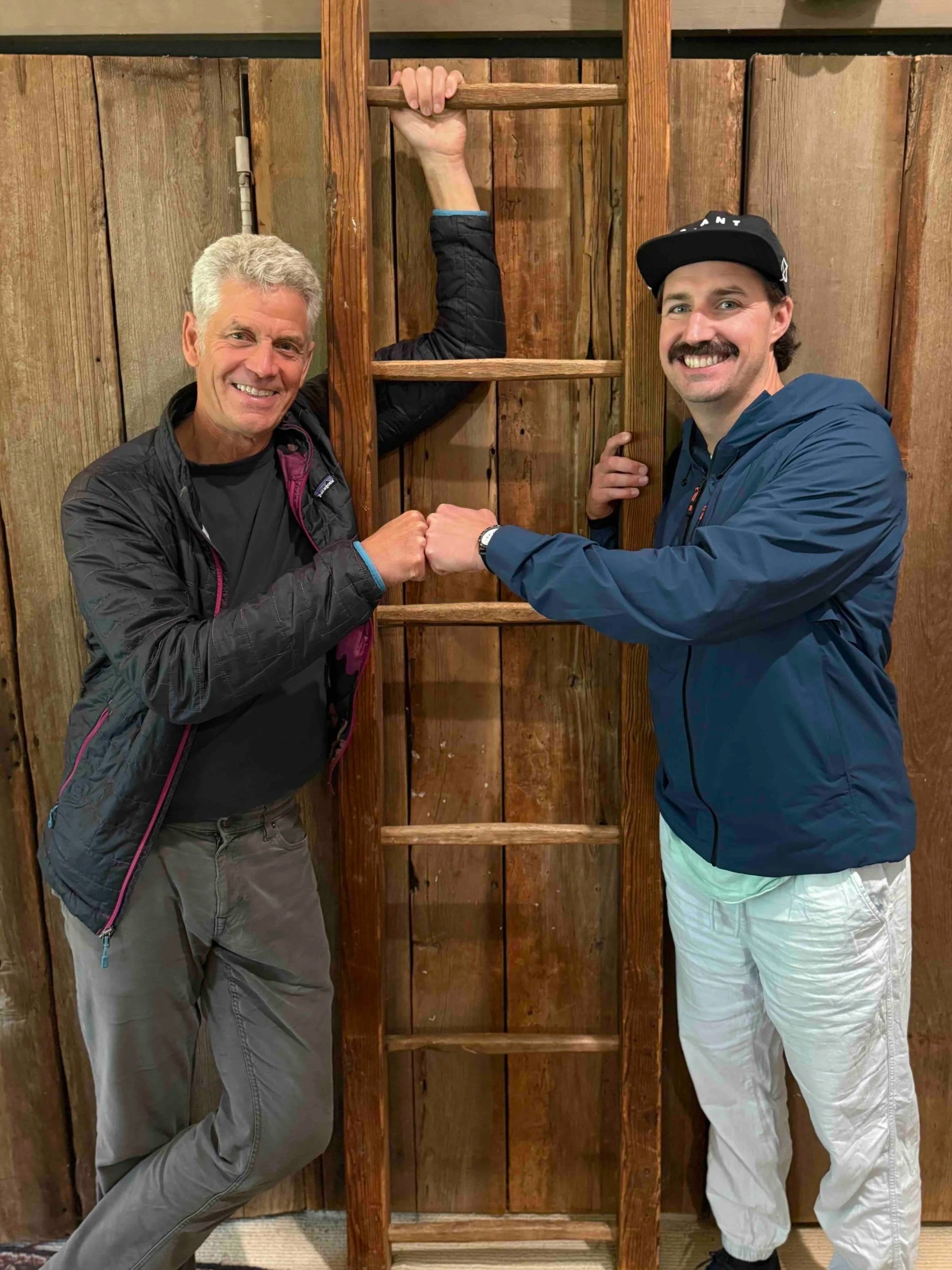
Rip and Andy Schaefer
Firefighters are trained to run toward danger — but too often, their own health is what’s at risk. In this episode of the Plant Strong Podcast, Rip sits down with fellow firefighter Andy Schaefer of Avon, Ohio, whose journey into plant-based eating began with a life-altering decision: donating one of his kidneys to his brother-in-law.
Determined to be as healthy and resilient as possible, Andy adopted a whole-food, plant-based lifestyle more than five years ago — and the results were undeniable. Faster recovery, dramatically improved biomarkers, more stamina on the fireground, and a renewed sense of purpose. Today, Andy is leading from the firehouse kitchen, fueling his crew with plant-strong meals that leave them feeling energized, focused, and ready to perform when the alarm sounds.
From zucchini fritters that changed an entire shift’s perspective on food, to the deeper reality that nearly 85% of fire calls are lifestyle-related medical emergencies, this conversation is about service, brotherhood, and reclaiming health — one plate at a time.
Key Takeaways
Peak performance starts with the fork. Andy’s plant-based diet helped him recover quickly from kidney donation surgery and outperform expectations on physically demanding fireground drills.
Leadership doesn’t require a badge or rank. By cooking plant-based meals at the firehouse, Andy inspired his crew to eat more plants, feel less fatigued, and perform better on shift.
Firefighters are tactical athletes. Like professional athletes, first responders must be ready at any moment — and nutrition plays a critical role in stamina, breathing control, and long-term health.
Sadly, nearly 85% of fire calls are lifestyle-related medical emergencies and not fires, at all.
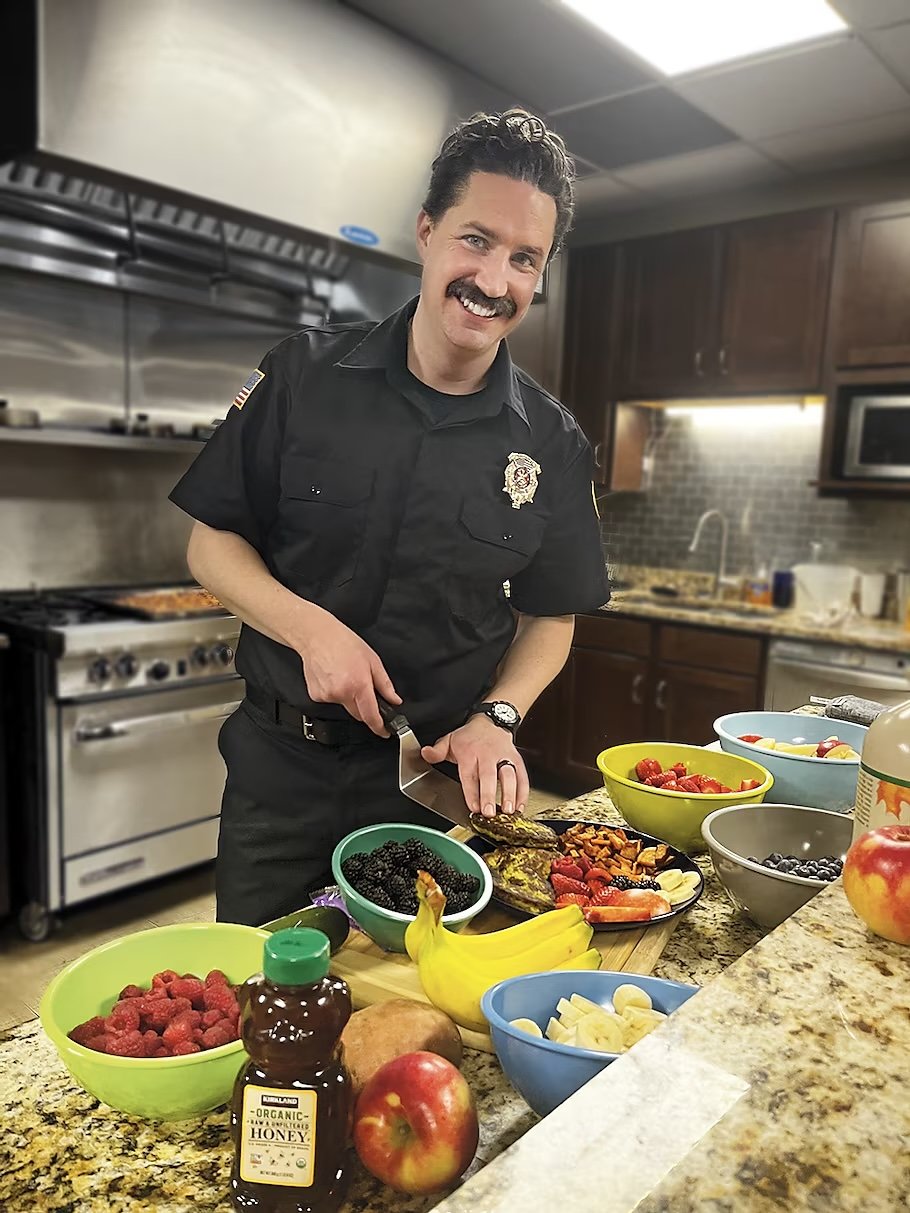
Firefighter, Andy Schaefer, preps his plant-strong foods!
Episode Resources
Watch the episode on YouTube: https://youtu.be/8xRKvMAuB8s
Andy’s article in Costco Connections: https://www.costcoconnection.com/july_2025/page4.html
We hope to see YOU at one of our 2026 Live Events! https://plantstrong.com/pages/events
Join thousands committing to 30 days, 30 minutes of movement, and 30 different plants each week with our FREE Real 30™ program
To stock up on the best-tasting, most convenient, 100% PLANTSTRONG foods, check out all of our PLANTSTRONG products: https://plantstrong.com/
Give us a like on the PLANTSTRONG Facebook Page and check out what being PLANSTRONG is all about. We always keep it stocked full of new content and updates, tips for healthy living, and delicious recipes, and you can even catch me LIVE on there!
We’ve also got an Instagram! Check us out and share your favorite PLANTSTRONG products and why you love it! Don’t forget to tag us using #goplantstrong 🌱💪
Episode Transcript via AI Transcription Service
I'm Rip Esselstyn and you're listening to the Plant Strong Podcast. As most of you know, my entire Engine Two and Plant Strong story was built on helping firefighters stay healthy and fit so they could keep on saving lives. Today, you're going to meet a firefighter from Ohio who is carrying that mission forward in a powerful way. Andy Schaefer transformed his own health through Plant Strong Eating and is now fueling his entire firehouse to feel stronger, less fatigued, and ready for whatever the job throws at him. This is Plant Strong in action and we're gonna have Andy's story right after these words.
speaker-0 (00:49.836)
Research consistently shows that investing in experiences supports long-term well-being. And that belief 100 % applies to Plant Strong Retreats. Our retreats are designed to help you step out of daily routines and focus fully on your health. With nourishing food, daily movement, guided reflection, and a supportive community, people leave feeling
grounded, confident, and equipped with habits that they can carry forward. If you're looking for a meaningful getaway that supports lasting change, I would love to welcome you. Join us in Black Mountain this April or Sedona this fall. For the next 10 days, a return to early bird pricing will be available if you use the code PODCAST at checkout. You can learn more at liveplanstrong.com.
And for healthcare providers listening, we know stepping away from your practice is not easy and continuing education needs to deliver real value. We hear the same question again and again. How do we move from lifestyle medicine theory to real world implementation? This is exactly why we created VitalScience. This event, it brings together leading clinicians, researchers and
practitioners who are actively applying lifestyle medicine in clinical settings. And the focus, it's practical, actionable education and peer connection around what truly supports patient behavior change. So if you're looking for implementation focused learning and a community committed to improving care delivery, we would be honored to have you join us at Vital Signs this June.
You can learn more about all of it at our events at liveplantstrong.com. Most of us don't struggle because we don't care about our health. We struggle because we're tired, busy, and standing in front of the fridge at the end of a long day wondering, what in the world am I going to make? And that's where your home matters. When your shelves are filled with delicious, simple,
speaker-0 (03:17.272)
whole plant foods, the right choice doesn't require a pep talk. It's just what's there. Dinner happens faster, snacking feels better, and eating well stops competing with the rest of your life. And this is exactly why the Plant Strong Food Line exists. To remove friction, reduce decisions, and make nourishing yourself feel natural, even on your busiest days.
You don't need more rules. You need better defaults. Shop at plantstrong.com and make it happen. Firefighters are built to run toward the fire, to serve, protect, and show up strong when it matters the most. My guest today, Andy Schaefer, lives that mission every single day. Andy is a firefighter in Avon, Ohio. And when he made the decision
to donate a kidney to his brother-in-law, he went all in on becoming the healthiest version of Andy, choosing a whole food, plant-strong lifestyle more than five years ago. We met in person at my parents' house in Cleveland, Ohio, and as firefighter brothers, we immediately bonded by a shared vision around saving lives, including our own. Today, Andy is leading from the Firehouse Kitchen.
and fuels his crew with plant-strong meals that leave them feeling stronger, less fatigued, and more prepared for the demands of this job. This is a powerful story of service, brotherhood, and what's possible when you choose to eat to thrive. Let's jump right in.
Andrew, great to see you. Great to have you on the Plant Strong podcast. So for those of you that have no idea who Andrew is, this is my first time meeting Andrew, but he's got a pretty spectacular story. He's also a firefighter. And so I thought he'd be a fantastic fit for the Plant Strong podcast. So why don't we start with this?
speaker-0 (05:35.328)
You just drove from the other side of Cleveland. I'm at my parents' house right now. I was here for Labor Day weekend, and this was the perfect opportunity for me to meet Andrew face to face and have him on the podcast. But you just came up from Avon, is that right? Correct. All right. Is that what, a 30 minute drive?
It was about 45-50 minutes. We got a little traffic. There was an accident on the way over, but right, about 45 minutes.
Right. And how long have you been living in the Cleveland area?
Almost my whole life. I had a stint where I lived in Columbus for about a year, but other than that my whole life Born here. Yep, right. Everybody's local. I'm one of six kids all local. So no nobody fled. Well, we're all together
So you're born here? Right. Your parents still here?
speaker-0 (06:24.782)
India, do you love Cleveland?
I do, I do. love the climate. I love the seasons that we have. Don't get me wrong, like vacationing and going south and west, but I think everyday living, it kind of hits everything that you could look for in a climate.
Yeah, what's the saying they say about Clevelanders like, cold hands, warm heart, something like that. Are you a Browns fan?
That sounds about right. I am, I am. I've lowered my expectations, you know, so I can make Sundays enjoyable, but I don't let it my day or anything like that. I have a lot of buddies who it'll kind of ruin their afternoons. but no, but yeah, I'll always support our Cleveland teams.
I can remember back in the day when we were like the cardiac kids and Brian Sipe was the quarterback and you know, we made some pretty close runs to the Superbowl, but yeah, I had many days and weeks where I was in a curled up a little ball, just like so upset. And at some point you realize I can't have this much emotion tied up into the Browns and if they win or lose, gosh. Well, wonderful.
speaker-1 (07:28.322)
Yeah.
speaker-0 (07:40.947)
When did you decide that you wanted to be a firefighter?
So I was in sales for about 10 years, essentially right when I got out of high school. And I did really well. I moved up in some ranks in some retail sales. And at some point, I figured out that I wasn't going to be able to do this forever, that one of my biggest goals in life was to be a really great family man and to be available to my children.
like whenever, as often as I could. I wanted to be a great dad. Like that was my kind of life's pursuit was I wanted to be a great dad. And at one point I realized that the complexity of the hours and kind of the grind and sales was not going to allow me to do that. And so I have some firemen in my family. And so one day I was sitting at my desk at work.
I said, you know what, I really wanna do something where that I can go home and I can be proud of what I did, the work that I accomplished. Not just for like my shareholders and CEO, but like for myself, for my family. And I looked into it and a couple of weeks later I enrolled in Tri-C Spire Academy and just kind of took off from there. And I mean, as you know, it's essentially maybe the one job that allows you to be.
proud of what you do, also be able to be there for your family all the time and be a great dad and husband. And that's, I haven't looked back since.
speaker-0 (09:15.608)
Yeah, and how old were you when you got into the fire department?
It's about 29. I was in school from about 26 to 28 and it's about 29 I got on.
So you were at what like going through fire academy and also did you get your paramedic?
Yes, okay. That was the bulk of the time. It took about a year for me to get my paramedic certifications
Wow, well congratulations on that. then.
speaker-0 (09:46.634)
was your heart set on being a firefighter in avon or just trying to become a firefighter somewhere in the cleveland area
So I wanted to be, initially I didn't really care where I went. I knew this was what I wanted to do. But what really turned me was while I was in paramedic school, we do a lot of clinical hours.
at fire departments, ambulance services to kind of hone in on our skills. And one of our locations where we could train was Avon Fire Department. So after one day of spending, you know, whatever my eight hour shift there, I fell in love. One of the...
One of the first guys that I met, his name was Jimmy Fisher. He's from the neighborhood that I grew up in. His wife was a teacher at the school that I went to. She was a teacher a little bit after I left elementary school.
But the way that he approached me and made everything super easy and was supportive, it just kind of like a bulb went off in my head. Like this is what I'm talking about. This is what I want to be a part of. People who care about the people who come in here. This guy loves his job. He cares so much about it that somebody that he's never met before, he was able to.
speaker-1 (11:05.59)
you know, have a conversation with, which is kind of rare. There are a lot of departments that aren't that big fans of students coming in and things like that. So this really stood out to me. And so I decided, hey, whenever there's a block open for clinical hours here, I'm going to put my name down so that I can scoop up as many as I can. And I spent most of my time there. And I got to know everybody that worked there. Great relationship. Made a really good impression on the chief at the time.
And when the time came to graduate, about a month after I got my paramedic certification, they hired me in part time. So it was all kind of, it's like a dream come true kind of thing. That was where I wanted to be. And they gave me an opportunity right away.
What's the size of the Avon fire department?
We have 36 shift members and then we have around seven to eight administrative. So we have 12 guys per shift on duty.
Got it. And so you got one station, one station, gotcha. So that sounds really, you know, quaint and very intimate.
speaker-1 (12:11.692)
Yes, it is. I really enjoy it because I get to be with so many people. A lot of different personalities. it is a great opportunity to get to know a lot of different people instead of just getting isolated with a couple. So you really get a chance to mold with a lot of different guys and learn a lot of different things about a of different people.
Yeah, I know the Austin Fire Department, know, I think now there's 53 fire stations, there's 1200 firefighters. You know, it's a bit of a beast, right? So there's something really attractive about a smaller fire department and really getting to.
developed those relationships with all those firefighters. Nicely done. And so what year was that that you actually got on with Avon?
So part time, that was 2018. And then I was offered a full time position in 2019.
2018.
speaker-0 (13:16.526)
Okay. Now, we're kind of like laying the map right now to why you're on the podcast. Obviously, love the fact that you're a firefighter, but more than that, you're a firefighter who also is plant strong. so that is, you've won me with that. so what I'd love to know,
and have you share with the Plant Strong audience is what caused you at the age of 29, 30, whatever it was, in 2019-ish, 2020, to pivot from, I'm assuming you were on the standard American diet or? Okay. From that to going plant-based. you, I'd love for you to share what happened.
Yes, I was.
speaker-1 (14:12.878)
So yeah, I just was on a normal standard of American diet. unfortunately, my brother-in-law, he's gone through some health troubles throughout his life. When he was 18, he needed a kidney transplant. And at that time, his creatinine was like 25 on a scale where it's supposed to be around one to two.
So he needed to have a kidney transplant. Now his dad at the time, and this was around 2003 I believe, was able to donate a kidney for him and save his life. That kidney lasted 10 years. And then at that point, my wife, she wasn't my wife at the time, we were together but we weren't married. She gave him her kidney. So that was his second transplant.
My wife's kidney lasted seven years. So that brings us to around 2019, 2020. Unfortunately, my brother-in-law was going back into kidney failure. And at the time, I had known that this was something that I wanted to do. If the event or if it happened where he was going to need another kidney, because at some point he was going to, that I wanted to be the one to do it.
So you have to be compatible? You do. And then just so happened that you were compatible?
So I contacted, and I didn't tell anybody that I did this because I didn't want anyone's hopes to get up. I didn't even tell my wife.
speaker-1 (15:44.758)
So I contacted the Cleveland Clinic and their donor office and said, you know, who I'm looking to potentially be a donor for. And there was a rigorous test testing process to go through lots of blood work day or an entire day's worth of doctor's appointments, just trying to see if you were compatible because it wasn't necessarily just blood type. There were a lot of other factors. I, have to be in very good physical condition and health in order to do this. And so I decided at that point,
I'm going to really ramp up fitness because I want to be far and away number one option for him. Working out twice a day, started to kind of watch what I was eating. And then I got the call, hey, from the Cleveland Clinic that, you you are the best candidate. You're also the youngest. Did you want to go through with this or did you want to? We have some other people in the pipeline that have also are going through this process.
So you mean other people that were in the pipeline for your brother-in-law? Yes. Okay, so he was going to have this done at the Cleveland Clinic? Okay.
And I said that, nope, I'm your man. I want to do it. So you can let everybody else know who I didn't know who it was. It was anonymous. I said, no, I'm your guy. I want to do it. And then I told my wife and she cried. Obviously she was proud, happy. And it was just a really good moment that the two of us had because she went through that experience.
And then my next step was I wasn't really ready to tell my brother-in-law yet. I wanted to make sure that all my other ducks were in a row. So I told my job first, actually. I sat them all down at dinner, all of them together, and I told them what I was doing. And I couldn't have gotten a better response from them. They were all honored. And right off the bat, they said, hey,
speaker-1 (17:47.958)
And I'd only been on for a year and a half at the time. So I didn't have much sick time accrued. The first thing that they said, we got you on sick time. know, whatever you need, we'll donate it to you. So you don't have to empty out all your banks to do this. This is something above, you know, everything that this is priority. We'll do whatever we can for you.
And typically, what's the recovery on?
So typically the recovery is so for this average person, it's six weeks. Now, as you know, being a fireman, there's a lot more to getting back to normal for our job, but still six weeks was my goal. So I didn't want to go a day past that because I was getting donated time. I didn't want guys to have to donate more time. So.
At that point, I got approval from work that we were good to go. I had the time to do it. And then I had this really corny idea to tell my brother-in-law, my father-in-law, my wife and myself, we all took a picture next to each other. And I had this really corny saying where it says, need a kidney. It's easy as one, two, three. And there's a picture of my father-in-law with the number one, my wife with the number two, and I was holding the number three. So he would understand, like get the message that I'm the number three.
Yeah.
speaker-1 (19:04.468)
And he called me right away with his wife and everybody was crying a little bit and just like happy, happy tears and all that sort of stuff. So that's kind of where everything started. I had some more appointments before the surgery because the surgery was about a month after this. And I went to the doctor.
Can I can I stop you for a sec? So no, no, no I'm just wondering so is he starting to go into kidney failure and what does that look like? And how I like what was the were you guys up against a timeline as far as like getting your kidney into his so that he's okay?
The sooner the better because we were holding off dialysis Now what I didn't know at the time is that he was on a plant-based diet to avoid dialysis so What happened was I went to my doctor the surgeon I'm sorry and a couple weeks before the operation and one of the things that he told me was that about five days before the operation he needs me to stop eating meat and When he said that I really didn't think of this my surgeon
As your doctor said.
And I remember on my drive home, that statement came back to me. I'm like, five days? Is that how long it takes your body to process this? That can't be right. So I looked it up, and it was right. And that kind of raised a flag. That's concerning. And so I remember my sister-in-law and brother-in-law had recommended this documentary, Game Changers.
speaker-1 (20:36.886)
I think it was because they were on a plant-based diet to avoid dialysis. So a couple days later, I saw it pop up on Netflix and I watched it and I saw the little preview of the man and he was trying to get back into his sport as soon as possible. Right. I'm like, this is right up my alley. Like I need to get back to work in six weeks and I need to be able to do my job to its full ability as soon as possible. So I watched it.
and it couldn't have been more reassuring. They're like, okay, adding into what my surgeon said about not eating meat, it's probably for anti-inflammatory as well. I'm like, all right, this is what I'm gonna do, because I need to be as in shape as I can when I'm done with this. And my wife had this great quote, she said, as healthy as you are when you go in, that's as healthy as you are when you go out. So if you wanna recover quicker, you have to be in...
peak condition going in. So we really ramped up exercise leading up to the, and this was all during COVID by the way. so surgery came and I got, so the day of surgery there, the hospital, you were not having guests. So I got dropped off in the middle of the night. My wife dropped me off. was in RLC in three days. So the whole operation, I was just by myself.
You
speaker-1 (22:00.078)
No family, friends, nothing, just the hospital staff. So after three days, my wife came and picked me up and the operation went well. The kidney took, he was doing great. He stayed in hospital little longer than I did.
So was he like in a room next to you?
No, he's on a different floor. So he gets like a premium suite. OK. As or no, I'm sorry. I got a premium suite. That's what it was because I was the donor.
The recipients put them in the basement.
More or less. So yeah, I got catered to while I was in there. That's for sure. The staff was incredible there for me and for him. But his day was a little bit longer because they needed to obviously make sure his testing and everything went well. And so that's when really the journey started.
speaker-0 (22:53.038)
Do remember what they fed you when you were in the hospital? Were you able to eat it?
Yeah, I believe I was. And I wasn't that hungry. Right. Yeah, I wasn't. I don't think I ate very much.
So anyway, so that's where the journey began.
Yeah. And so I held the plant based diet throughout my recovery after a week or during that first week I came home, I was walking around the block week two, I was jogging around the block. And then it was time to get back to work and I was ready at the six week to the day. I and I was ready to get back.
Now, what's it like with only one kidney? Can you notice, is there any noticeable side effects or like do you pee more or what happens when you have only one kidney?
speaker-1 (23:43.086)
So you can live a fully functional life. I don't notice it. But I knew going in that I needed to take way better care of myself because I wanted to be around for a long time. I went, I guess you could say I went to some extreme lengths to keep it healthy. I mean, you wouldn't say going plant-based for life is extreme, but.
Like my father-in-law, he's not on a plant-based diet. He does well. My wife, same thing. Yeah, you live normal lives, you don't notice. You just have to be careful if you have kidney issues. You just stay hydrated. That's key. Don't get dehydrated. You don't want the kidney to overwork because you're just down to one.
So just help me recount so right now the number of people in your family that have one kidney are yourself your wife and then your wife's father correct and and then also Your brother-in-law. He's got one kidney. Is that right? Kidney. Yeah
So it's your. Yes, it my kidney. So a little bit of a wrinkle into this story, which my my brother-in-law passed away this spring. Not from kidney failure. Yeah, he unfortunately had a heart attack that they weren't able to catch in time. So he actually passed away this spring. So my kidney only lasted five years for him. Right. Yeah. But. But yeah.
How old was he? 43. And did you say, he, had he started or was he doing a plant-based diet?
speaker-1 (25:24.398)
43.
speaker-1 (25:32.75)
I didn't hound him about it. You know, I, didn't do it to, I did it just to give him some more time. so I think as a family they did here and there, but I didn't really keep much track of what they were eating. didn't want to impose, you know, it's one of those tricky things. You don't really want to go too far. you want to people to live their life. I did what I wanted to do and
Yeah.
whatever they decided as a family that's what they would do.
Yeah. So for, I mean, so is that, some heart disease run in the family? Are you aware of that or no?
No, don't get me wrong. like the reason that he needed so many kidneys was he was having like an autoimmune, some sort of autoimmune disorder. And he had been on a lot of medication for years, just making sure that everything was functioning properly. And it's just takes a toll on the body for 20 years. So it was just one of those things, you know, was it related to all of that? It might have been, but it's really hard to tell.
speaker-0 (26:28.664)
Yeah.
speaker-0 (26:37.068)
Yeah. All right. So you said you've got two young children, right? And what are their names and ages?
I do.
Reid is four and Cecilia is two. She'll be two in October, so next month.
and is your is your is your wife onboard in support of with although you know
She sure is. sure is. At first I told her, hey, you don't have to do this. You know, this is just something I want to do. I'm not going to get upset if you want to keep doing what you were doing. But she's the most supportive person I've ever met. And she was all on board, whatever it is crazy venture I want to get into when it comes to health or she's always on board because she knows that.
speaker-1 (27:24.332)
I spend the time doing the research and finding out what's best. And at end of the day, our family is the most important thing. And if it keeps our family healthy, then, or at peak health, she's all about it.
Sort of the two and the four year old starting down a plant-based path too.
They sure are. When it comes to how I approach it, is I like to call it like a the real world approach to it. So in our house, we are plant based. don't buy, go to the store and buy anything that's not plant based. Now, of course, like every, every family, grandma and grandpa and mom and papa, they, you know, they want to spoil the kids and, you know, there's birthday parties and things like that. And
You know, we don't want them to feel like left out or isolated or anything like that. We want them to experience what all the other kids experience too. But we control what we can control is, I think, the best way to say it. So my son, he occasionally says that he wants meat, but he
Yeah.
speaker-1 (28:32.128)
is four and he thinks he's a dinosaur 50 % of the time and he knows some dinosaurs he meet. So that's why he'll say that.
But the biggest baddest dinosaurs usually are herbivores.
That's right. He's he doesn't want to hear that. OK, he doesn't want to hear that. But he knows that we're plant based and sometimes he'll just to kind of stick it to me. He'll say he got he he calls me Gaga's. Hey, Gaga. I have meat. Just because he knows it like not that I'm going to like say anything about it, but he knows, hey, I know you were not supposed to eat this.
You
speaker-0 (29:08.216)
But I'm eating it. Trying to get a rise out of
But you know that phase will go away and he loves all the plant-based food that we make My daughter eats anything which is awesome So whatever we put in front of her she eats it. So we just limit limit I guess kind of with that real-world approach
Yeah, I think that's a I really think it's a healthy philosophy real-world approach. I that makes a lot of sense Now I think one of the reasons why we discovered you is because of an article that was in some Costco paper Costco connection that that's it and they did something on I think a bunch of firefighters and Some of their favorite meals if I'm not mistaken
right? The Costco connection.
speaker-1 (29:58.702)
That's right.
And yours was like these zucchini fritters, right? Right. And where did you get that recipe?
So I got the recipe from my wife. One of the great things about my wife is she, before we went plant based, she wasn't that great of a cook. She didn't have like any natural instincts or anything like that. So when we went plant based, she kind of started from the beginning, which was awesome. She didn't have to like fix any old habits or anything like that. So she dove right in and she likes trying new stuff. So one morning she made some zucchini fritters and a recipe she found.
And as we were eating it, a couple of bites in, I'm like, oh my God, guys, I have to take this to the firehouse. They will eat this. This is incredible. And it was interesting that right around that time, since I've been plant-based, know, everybody takes turns cooking at the firehouse. I would always, you know, make, make sure I had my meals. The guys at work have been phenomenal. I know a lot of firemen who are plant-based have.
Yeah.
speaker-1 (31:01.39)
you know, difficult time sometimes. The guys that I work with are incredible. They'll always ask me, hey, this is what we're making. Is there a substitute I can pick up for you while I'm at the store? Like incredible. If not, I always have stuff, you know, organic veggies in the freezer, all that sort of stuff, some rice. You helped me out with lot of that. And so for a while there, when it was my turn to cook, I would make two different meals. I would make myself food, anyone who else wanted a plant based meal that day, and I would make food for everybody else.
Just because I wanted to keep everybody happy and then at some point last year around the summertime It kind of hit me. I went home after work one day and I told my wife I said Al I can't make this food for them anymore. Like I I just can't As I'm cooking it. I just I can't knowing what I know. I can't do this to my to my guys And then right after that I was like, you know what? I'm gonna next time I cook we're gonna make the fritters and we're gonna start there
And so I was ready. went to work that next weekend. It was my turn to cook. said, guys, ahead of time, I'm making a plant-based meal. So if anybody has any objection to that, let me know. But that's my plan. Is everybody cool? They're like, all right, yeah, let's do it. So I made the fritters. I made some sweet potatoes with some cinnamon, some honey, and a whole bunch of fresh fruit. And they devoured all of it. All of it.
.
But the best part about it was obviously they, you know, complimented how good it was, was their reactions afterwards. I feel like I don't need to take a nap right now, which is typically what happens after breakfast at work. I feel like can go work out right now. Like, do you feel like this all the time when you eat? said, absolutely. That's what I feel like. Like, wow, maybe we should do more of this. So that was the best compliment I could have ever had. And then from there,
speaker-0 (32:39.726)
Yeah.
speaker-1 (33:00.192)
After that day, anytime it's my turn to cook, we're going plant based.
We're zucchini fritters.
So, and it was easy. All the other food that I would just make in the past, I just added the plant-based ingredients and they still got awesome reviews. mean, your book changed my life, I have to say. So not only mine, but like my family's. So the best thing that I got out of that book was when you're new in plant-based eating, you are trying to figure out quadrants on a plate. Like I need this, I need that, I need this and that.
And your concept of you have all this ingredients, all this great food, just put it together and cook it and eat it. And we, that's what we do at our house all the time. Put it in a bowl. We have this great food, just cook it and eat it. You know, there's no reason to overthink it. You don't have to get a recipe, you know, and I think that's the key to being consistent with the plant-based diet is just, just put it together and eat it. And it's awesome. It's always delicious.
Mm-hmm.
speaker-0 (34:01.262)
Yeah.
How many firefighters do you have on each shift? Is it 12 or is it less? Okay. So when it's time for you to cook, you're cooking for 12.
We have 12.
speaker-1 (34:14.178)
Typically not, it's typically around eight or nine. But yeah.
Okay, so what do you have there? Do you have an engine and a ladder?
So we have one ladder, two engines, and after next month we'll have four ambulances. Wow. That's the bulk of our...
what we do. how many firefighters do you have on each engine and the ladder? So is it run three or four?
So four on an engine, three on the ladder typically. And then we have, depending on staffing, cause it kind of fluctuates, we'll have our shift captain and one of our other firefighters go on an ambulance.
speaker-0 (34:56.216)
Have any of the other guys or gals, you have any women? So have any of the other guys become more plant-based outside of the fire station when you're cooking?
We do not.
speaker-1 (35:12.718)
Um, so we just kind of the shift that I'm with now, we just got together this, this January. So it's kind of, it was one of the shift shakeups and they all knew going in that I was plant based. And as a shift, I'm really proud of all of them. Whenever anybody cooks, it's 90 % plants. Um, they'll still kind of cook some of the other stuff, but they go, we go out of our way to make sure that we got tons of nutrients, tons of nutrition, tons of plants at every meal.
And a lot of the guys do they don't go full plant-based, you know at home but They'll take some of the recipes that I make and they'll take them home with them I get a lot of requests for hey, can you send me that? know, I might want to make that at home or So at least this year, I know that the guys that I work with now They definitely are factoring it more into their lives at home
The zucchini fritters, which made you famous with the Costco connection. Are those deep fried or are they baked? What's the methodology?
So they're essentially just pan seared to kind of get them nice golden brown. And then once the outsides are golden brown, I put them in the oven and just cook the rest of them or cook the rest of it inside.
because I typically, I can't stand eggplant. I usually have a hard time with squashes and zucchinis, but I'd love to try yours to see if I like them.
speaker-1 (36:37.482)
Yeah, it's a favorite at the firehouse. When when Costco asked me to do like a photo shoot at the firehouse, everybody came. Everybody came. We had our our fire department chaplain came one of the fireman's dads. All the administration was there.
my god. This is bigger than the New York Times. The Costco connection.
They all wanted a part of it. Everybody ate. was there wasn't we had to eat at our kitchen table. We had to eat at the counter. It was loaded. We made tons.
my gosh. Now, did you have to be a member of Costco in order to get into the Costco connection?
I don't think so, three quarters of the way through the process is when they finally asked me if I was even a member. am, yeah.
speaker-0 (37:25.102)
Are you a member? We love Glasgow. Yeah, yeah, wow. So now are you a firefighter or fires in Austin? It goes basically firefighter, fire specialist, lieutenant, then, know, captain, stuff like that. Are you a firefighter?
I'm a firefighter. Yeah, so we have on our ship to 12 we have nine firemen Two lieutenants and a captain on each other
Yeah. All right. So what do you think? How many years you want to be a firefighter?
speaker-1 (38:04.758)
Well, my goal is to get my 25. You know, I think, because I got on when I was 30. At 55, you know, taking care of myself as well as I plan to and as I do now, I want to have a whole second life after the fire service. So as long as I can do it, I'll do it. And then when that time comes, you know, I have a lot of other ideas that I want to do afterwards. So as long as I'll have me, guess.
I mean, it's such an amazing profession and the fact that it, you know, 25 years at the age of 55, you can get a great, you know, salary, right? For the rest of your life and then start another career or passion. That's really great. What'd you have for breakfast this morning?
So I knew I was going to eat here. So I didn't get too much this morning. My wife makes some incredible from scratch waffles. The kids love them. So I had a waffle, all plant based. I just did. So I just had one about a month ago for the first time. And I can't say anything bad about my wife. They were equal.
You haven't tried our plant strong like it. Okay.
speaker-0 (39:26.989)
Okay.
They were equal. Right. So they were phenomenal. So I had that with some bananas and blueberries and some some organic peanut butter. So I just had one. Yeah. Yeah. Wanted to make sure I was ready to eat later today.
So are you a fan of cereal, oatmeal? Do you have like a go-to breakfast?
So at the firehouse, do have a go to breakfast. I have a giant bowl of assorted fruit, blueberries, strawberries, raspberries, like mango, pineapple, bunch of seeds I put in there, flaxseed, chia seed, hemp seed, some adaptogens, peanut butter, all that sort of stuff, a big bowl.
big bowl of, that sounds like dessert.
speaker-1 (40:15.702)
It kind of is. all the time. Why not? When they're all plants, what could go wrong?
Yeah, so that sounds almost like my bowl except I add a little bit of know the cereal on top and then some milk right some plant-strong milk and I call it good, but I like But I do a grapefruit. I do banana. do kiwi typically mango I'm gonna do do you do fresh or do you frozen?
Typically he's frozen because I leave them at work. So I like to ride my bike to work a lot so I can't be home what could be sometimes three meals a day. So I leave a whole bunch of frozen organic fruit at the firehouse.
Yeah.
speaker-0 (40:57.314)
Yeah.
speaker-0 (41:01.784)
How far is the bike ride to the fire station? Two miles. It's perfect. get there and you're like revved up, ready to go. yeah. That's good. So let's just go back to a second to your recovery after your, your kidney was removed. What, what, Hey, what is the doctor, the JASTA doctor like, Hey, what do you think about me going on this plant-based diet to expedite my recovery? And if you had any biomarkers or
baseline measurements that were done that then you were able to have follow-up and Like are you just kicking ass and taking names or what's going on there?
So I told the surgeon after that I was on a plant-based diet and he said that that was absolutely great. Keep that up, that's gonna help you recover and that's just a great way to take care of a kidney. And if you can do it as long as possible, do it. And as far as markers go, I mean, I was in my early 30s and I didn't really go get blood work done all the time. So I didn't really know what my cholesterol would have been or.
anything like that before. But I, my first set of blood work, like I had mentioned that I had really ramped up exercise, I'd started eating a little bit cleaner. It was, it was desirable cholesterol, I can't remember what the number was, but it was still it was good. It was in the good range. And then after the surgery, some of those future blood works, they were incredible, right? With just one change.
just with what I was eating. if I didn't, I wasn't able to exercise all that much like normal, like would I'd like prior to surgery. So this was all just what I was eating. And just walking and light jogging and that alone, like it was shocking like cholesterol numbers. Remember at one of the tests, my triglycerides dropped by 90 points. And I was just like, wow, that was some crazy numbers.
speaker-0 (43:11.15)
Yeah, and for the audience, know, the triglyceride is a function of how much really fat is in your blood. And so to come down, you know, 90 points from whatever it was is that's not nothing.
Yeah, I was thinking it was like 151 and it was down to five or something like that.
Yeah, so probably. Yeah, nicely done. All right. Let's go back. You mentioned two fire engines. Do you guys call it a ladder truck or what? So two engines, a ladder. Did you say four ambulances?
We have three right now. Three. We get our fourth one coming next.
Okay, tell me what percentage of your call volume at Avon Fire are medical emergencies? 85%.
speaker-1 (43:56.11)
Probably about 85, I would say. Between 80 to 85, probably close.
And of those 85 % of those medical calls, what percent are typically due to, I think what you and I would consider due to kind of lifestyle created ailments, whether it's shortness of breath, a diabetic emergency, low blood sugar, whatever.
Way more than half. And I know you've spoke about this in the past. It's knowing what you know, sometimes it's hard. Because you don't really want to step out of your lane. There's only so much you can do to educate the public that you're with for five minutes. In a lot of cases, they don't want to hear it. They got their own problem going on. Sometimes, I'm not going to lie to you, sometimes I
I do talk to the patients in the back of the ambulance about certain things. Just like little changes. Why are you on this med? Or what are your numbers? Maybe consider other things. The one last time you went to your doctor, some people have like 30 medications in a little baggie that they bring to the hospital. you're like, well.
it's, it's hard sometimes you feel for them, but you also feel for somebody. This isn't really helped the people that are supposed to be helping them really are helping them. it can be tough sometimes. So it's, it's tough.
speaker-0 (45:32.846)
If there was one medical emergency that you see more than any other, what would you say it is?
Um, people fall all the time and even we, we joke that they have on gravity is a little different. Um, and a lot of that just comes down to balance issues. And, a lot of the, typically the real skinny people don't fall. Um, you know, it's the people that are typically overweight. They, um, it's hard for them to kind of move around and, you know, pick their feet up and things like that and just do.
Yeah.
speaker-1 (46:12.492)
daily functions and the ages range. It's not just, know, it's, it's something that's probably the most common call that we go on are people that fall and injuries that happen on top of that.
The elderly.
speaker-0 (46:27.308)
Yeah. So now that you've I'm gonna just say Plant Strong for five years. Give me a little fist bump, my man. Have you noticed any benefits in being a firefighter that have kind of accrued that you maybe have witnessed over your firefighting brothers?
Absolutely. the one of the things that we like to do is like every year we have what we call like a work cycle, like breathe down drill. And essentially what we do is we put on all of our gear, we put on our air tanks, and we do, you know, drills physical activity for as long as it takes until your air cylinder runs out. Right.
there's a number of guys who they don't like that drill. So they do. They try to use as much as possible so they can end it. But I always took that as a point of pride. And I mean, for looking at me like I'm you know, jacked or ripped, anything like that. just, I like to consider myself just an average looking guy. You know, I have two little kids. I don't get to the gym six hours a day like some people do.
But just like what I do, physical fitness wise, and primarily what I eat, it allows me to do significantly more than you would think. I am always at the top of the list as far as time. I can do all the drills in this drill a lot longer than before. And then a lot of my coworkers as well, younger, more active, more fit, just the...
what you put on your fork will get you further. It's crazy that it's something that simple that even guys who are in great shape, they just won't go as long as guys whose blood is flowing different.
speaker-0 (48:32.654)
Yeah. So, so the, the listener kind of, kind of comprehend this. So this is, so you're wearing an SCBA, self-contained breathing apparatus. And is this a 20 minute bottle of what, like, do know typically like what, maybe it's, I don't know what it is these days. I've been retired for 15 years, but is it, what's like, what's, cause we have two different size bottles that we put on our back.
Do you have one?
We just used one, and I believe it's a 45-minute bottle.
45. Okay. And so give me an example. So you're doing your drills and then you sit down and then you just kind of go until you run out of air. Is that right?
So we perform our activity that we're doing, and then we will do some sort of cardiovascular.
speaker-0 (49:28.078)
exercise.
Yeah, some sort of cardiovascular exercise until you run out. And the guys who are doing those cardiovascular activities for a really long time are the ones that that last the longest.
Yeah. And so give me an idea, like how long sometimes have you lasted?
Um, just under an hour in some of them, um, we've kind of really amped up the drills. Um, but I can go nonstop physical activity for the 45 minute number is just kind of like, you're just essentially just standing there and just breathing, um, I could typically go 30 to 40 minutes of
high cardiovascular activity with that bottle where a lot of other firemen will go 20 minutes kind of thing. So in a lot of cases, it's kind of double.
speaker-0 (50:22.222)
Yeah, that's super impressive. Like I know sometimes you're fighting a fire and you get all jacked up and you're breathing like a racehorse and that 45 minute bottle will last you 12 minutes. So it's a good exercise and it's a good drill to do and it's nice if you can do your best to stay calm mentally. And there's a lot going on there.
Yeah, absolutely. Right.
speaker-1 (50:48.308)
Absolutely.
Yeah, I think that's kind of half the battle as far as breathing goes. And that's one thing I pride myself on is I stay in the moment when the fire alarm goes off. I don't get too excited. I'm not like the adrenaline junkie guy who gets amped up. I stay level-headed. I know that there's potentially a lot of decisions that need to be made with clear heads.
so I know that going in, I don't know what just kind of naturally came to me that way. I was never really like that, fire junkie. Yeah. so I think just having a level head and being able to control your breathing, cause each breath will count. So knowing how to breathe properly and stay calm in those events are like, said, like you said, like half the half the battle.
Yeah, well said. So you know that I was a firefighter in Austin, Texas for 12 years. I started my career plant-based. I've now written four different books. I have a whole ecosystem around trying to get people to go plant strong. What would you
you know, having done this now for five years, understanding the huge benefits that you, that ensue upon you when you eat this way. What would you say to all your firefighting brothers and sisters that are out there and are kind of habituated on, you know, the meat, the fried food and all that stuff. And you and I both know that the number one cause of firefighter fatalities
speaker-0 (52:34.274)
in the line of duty is from heart attacks. So, just, I'd love to hear from your perspective, what would you tell these guys?
So The one thing that I always say is For me Once you know what it feels like to feel great Why would you ever want to feel anything less than that? Mm-hmm, but you have to know what it feels like first and That's why I always tell guys. Hey, just let me make you something. Let's try it You don't have to do it for the rest of your life but just Get a feel for what this can do to you
because what I like to say our job is is we're like the second string like professional athlete. We don't go to fires 10 times a day. So I I wouldn't consider us the starters. But you have to be ready when your numbers called. And if you look at a professional athlete, what they do is they are on top of their game. They they care about what they put in their body. They are physically mentally ready.
all the time, even though they're, may not be in the game just yet, but at some point they're going to be, and they need to be ready. And I think what happens with a lot of the fire services guys kind of get lackadaisical. They kind of get set in their ways, from physical fitness to what they eat, you know, number of shifts go by and you know, not no big action happens. So they think they can just kind of keep going along with that. And, but at any given time,
Bell's gonna go off and it's gonna be serious and everybody needs to be on board and everybody has to do their job. Like an NFL team, Bill Belichick always used to say from the Patriots, just do your job. And that couldn't be more important on a fire ground or than on like a serious like medical incident. Everybody has to be able to do their job because if you can't do your job, then I can't do mine.
speaker-1 (54:39.106)
From the fire service perspective, that's most important. We have to be able to do our job. And as far as afterwards, like everybody wants to retire from this place and everybody wants to have a fulfilling life. And unfortunately, too many firemen pass away right after they retire where they don't get to reap the benefits of what they've done or the money that they've accrued. And at the end of the day, that is what's most important, your family, your friends. Those are the people you wanna be around.
And that will taking care of yourself and what you put in your body is going to allow you to enjoy life after the race. Which is the most important thing at the end of the day.
Yeah beautifully said beautifully said well, I Just want to close by saying how much I appreciate you Huffing it from the west side over here to the east side on this kind of chilly Cleveland day I want you to know how much I appreciate you as a firefighting brother that is representing the lifestyle what a
big heart you have to have given your your one of your kidneys to your brother-in-law that's just like magnificent and i want you to know that i will always think of you whenever i walk into a Costco a and then and then b i need to try zucchini fritters at some point yeah yeah so andrew give me a Plant Strong fist bump
Absolutely.
speaker-0 (56:17.084)
and I wish you all the best.
Thank you, Ripper. It was awesome being here. I appreciate the time. Absolutely.
Yeah, let's go get some lunch. right. Woohoo! What Andy is doing reminds us that leadership doesn't always come from the front of the truck or while fighting a fire. Sometimes it starts in the kitchen. And by choosing Plant Strong foods, Andy's not only protecting his own health after a life saving kidney donation, he's empowering his firefighting brothers and sisters.
perform at their absolute best. And this is what Plant Strong is all about. Fueling the people who serve others so they can keep showing up strong day after day. And I'm also talking about you, moms and dads. If this episode inspires you, share it with someone who wears a uniform, serves their community, or just wants to take better care of their one
precious body. Until next time, as always, always keep it Plant Strong.