#335: Dr. Will Bulsiewicz - The Plant Powered Plus Blueprint: Your Step-by-Step Path Out of Inflammation
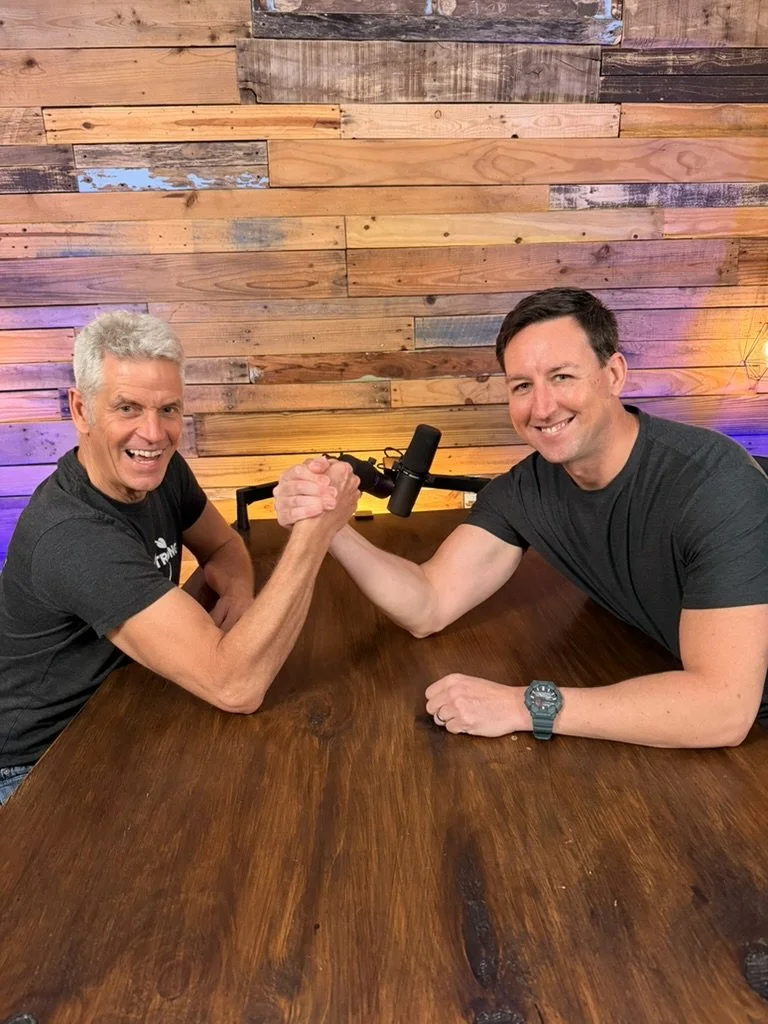
Rip and Dr. B fueling their guts and their guns with plant power!
Inflammation is running rampant — and it’s not starting in your joints or your arteries. It’s starting in your gut.
This week, Rip is joined by world-renowned gut health expert Dr. Will Bulsiewicz, aka “Dr. B,” author of the book Plant Powered Plus. (Release Date: January 13, 2026) Together, they break down why chronic disease, fatigue, weight gain, autoimmune disorders, and even emotional burnout so often trace back to what’s happening inside your microbiome.
Dr. B reveals his powerful three-phase gut-healing plan, explains why fiber is the undisputed MVP of human health, and shows how plant diversity, fermentation, and polyphenol-rich foods can radically change your life — starting today.
But this episode goes deeper than food.
Rip and Dr. B explore the profound connection between emotional healing, spiritual wellness, and physical health, including Dr. B’s personal story of reconciling with his father and how unresolved trauma can live in the body.
This is not about perfection.
It’s about progress.
And it all starts with your next bite.
You’ll Hear:
Why inflammation is a national pandemic — and how your gut is at the center of it.
Dr. B’s three-phase approach to healing your microbiome and lowering chronic inflammation.
Why fiber deficiency is fueling modern disease — and how to reverse it.
The four nutrition “workhorses” of true plant-powered living.
How polyphenols, fermented foods, and healthy fats supercharge gut health.
The hidden dangers of the Western diet, hyper-palatable foods, plastics, and environmental toxins.
How emotional and spiritual health directly influence your physical healing.
Your gut isn’t just digesting food — it’s shaping your immune system, your emotions, your energy, and your future.
Dr. B and Rip remind us that real healing doesn’t come from chasing symptoms.
It comes from changing the system — one fiber-rich, plant-powered meal at a time.
Pre-order Plant Powered Plus and start building a life that’s not just longer — but stronger. 💪🌱
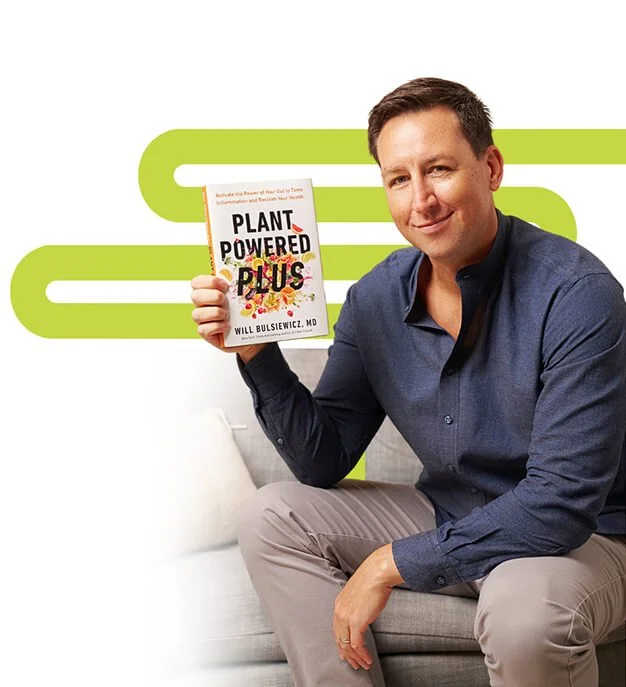
Order Plant-Powered Plus
Episode Resources
Watch the episode on YouTube: https://youtu.be/gRx-2lR0Dbc
Order Plant Powered Plus
We hope to see YOU at one of our 2026 Live Events! https://plantstrong.com/pages/events
To stock up on the best-tasting, most convenient, 100% PLANTSTRONG foods, check out all of our PLANTSTRONG products: https://plantstrong.com/
Give us a like on the PLANTSTRONG Facebook Page and check out what being PLANSTRONG is all about. We always keep it stocked full of new content and updates, tips for healthy living, and delicious recipes, and you can even catch me LIVE on there!
We’ve also got an Instagram! Check us out and share your favorite PLANTSTRONG products and why you love it! Don’t forget to tag us using #goplantstrong 🌱💪
Episode Transcript via AI Transcription Service
I'm Rip Esselstyn, and you're listening to the Plant Strong Podcast.
[0:05] Inflammation is like taking a wrecking ball to your health, and most people don't know which direction to start attacking it from. Today on the Plant Strong Podcast, I am joined by Dr. Will Bulsiewicz, Dr. B-Baby. He is one of the world's leading gut health experts, and we're going to talk about his new book, Plant-Powered Plus. We're going to be breaking down why inflammation actually has its inception point in the gut and how fiber-starved diets are fueling all of this chronic Western disease and how a plant-powered approach can flip the switch on healing. If you're tired of chasing symptoms and you're ready to fix the root causation, then stay tuned because Dr. B is coming up right after these words from PlantStrong. If you're listening to this right now in this moment in time, and you're thinking, this is the year that I want to feel different. I want to feel stronger, lighter, more energized. This is your official invitation.
[1:18] I'm going to be kicking off the Real 30. It's a simple, powerful 30-day challenge that's rooted in real food, real movement, and real habits that all actually stick. There's no extremes.
[1:34] There's no perfection. This is just a chance to reset your relationship with food, allow you to reconnect with your body, and do it alongside a community that is in it to win it with you. If you've ever wanted a fresh start, but one that feels sustainable, Real 30 starts now. I would encourage you to join us. Let's make this a real beginning. Just visit the show notes or you can go to planstrong.com to join for free. And if you're ready to take the reset even further, I want you to know that our retreats are something truly special. These aren't just trips. They are life-changing vacations. It's a chance to step away from all the noise, eat incredible food, move your body, learn from inspiring experts and reconnect with what really, truly matters. And I want to make this super easy for you to say yes, so I'm extending our podcast-only bonus, $300 off our April retreat when you use the code PODCAST, P-O-D-C-A-S-T, and it's good through January 15th. If you've been waiting for the exact right moment to invest in yourself, this is it. And I'd love to welcome you and meet you.
[2:58] Team, this is a big one. Dr. Will Bulsiewicz is back and his brand new book, Plant Powered Plus, drops January 13th. This book isn't just theory and hype. This is a step-by-step, three-phase plan to heal your gut, help tame that inflammation, and take back your health. And every time that I talk to Dr. B, I love going deep because he is so incredibly knowledgeable on this specific topic of gut health. So grab your pen and paper for this one, or better yet, pre-order the book because if inflammation, autoimmune issues, or chronic fatigue have been holding you back, this conversation and his new book will give you a clear path forward through all the fog and the confusion and misinformation. Let's welcome back to the Plant Strong Podcast, Dr. Will Bulsiewicz.
[4:05] Plant Strong people, I am here with Dr. Will Bulsiewicz in Austin, Texas. We are together in person. I mean, you've been on the show at least three times. And this is the first time we've had the pleasure of doing a podcast live. And it's really nice to have this level of intimacy. Yeah, well, we do our best work in person, you and I. So we've proven this at the Plant Strong events, the retreats and whatnot, um where we always have an awesome time so and um i have to say though that the bar feels a bit high because our first episode rip and i know i've said this to you before but i'm gonna say it to everyone listening it was a moment for me and that was it came out um the week before fiber fueled launched in 2020 so like i could almost say like if we went back and looked at the calendar it was probably like May 7th or so that it came out.
[5:07] And I was an author who had worked his tail off to create a book, writing at five in the morning, working full time, taking call every third night as a gastroenterologist. And it felt like the pandemic started, took the wind out of my sails. And I thought, gosh, I put all this effort in and I don't know that anyone's going to know about this book. I don't know that anyone's going to read it. Rich Roll, who's a friend of mine. He, but like he had to cancel on me. Yeah. Right. Because of the pandemic.
[5:36] So, and then your podcast comes along and all of a sudden it's like, you could watch the Amazon rankings as they climbed your community showed up for me and for fiber fueled. And that was the beginning of this entire journey that we sit here today to discuss. So I have to thank you, but I also want really want to say thank you to your community who has supported me and my work. and I hope to not let them down with this next book. I'm really excited about it.
[6:04] So are we. And I'm sure, You know, this was the first one, right, that you just talked about, fiber-fueled. As we talked about, we have the exploding haywood kiwi on the front. You always get me on the type. I know. The second book was fiber-fueled cookbook. And again, we had the exploding haywood kiwi on the front. And this time, it's not fiber-fueled plus, it's plant-powered plus. And we have an explosion of everything from kiwis to karakara oranges to broccoli, cruciferous, you know, greens. It's amazing.
The Importance of Plant-Powered Nutrition
[6:48] Yeah. Right? Yeah. We're going all out. We're not holding back anymore. We're pulling out all the stops here on the Plant Powered Plus.
[6:57] Tell me, why Plant Powered Plus instead of Fiber Fueled Plus? Um well in a way i want to look i want to look at what is the goal right what is the goal what are we here for and in my mind the first book fiber fueled was a conversation about the gut microbiome that no one had heard anything about right from a credible source and the things that i was seeing in my clinic for many years um but that's kind of basic to be honest yeah and the cookbook was the, was the response to all the people who followed the fiber field for weeks and who were well-intended people, but wrote in to tell me that they were struggling to, to follow the diet. And that's because they have food intolerances and their gut is, uh, unwell. And so we can address that. So I wanted to walk them through the protocol for how to get there. That was the cookbook. Here we are. And I'm ready to take on this. I feel like a more mature author? And, and I'm blessed with an opportunity to write a book and I could write about anything, right? My, my, my team, by the way, Lucia from my, who's my editor and who you're, you and your family knows quite well. She published your father's first book, prevent and reverse heart disease, which is an all timer from that publisher.
[8:20] Um, she says, hi, by the way, uh, she would support me on just about anything that I wanted to write about. And I turned, I said, what is the health related problem of our time? And there's a clear one word answer, inflammation.
[8:38] And this is not just like a feeling. This is overwhelming evidence that when we look at the chronic inflammatory health conditions that we are stricken with, they are the ones that are most prevalent. They're the ones that are causing the most morbidity, the most death, three out of five causes of death include something on the death certificate that is an inflammatory health condition. And I actually think that's an underestimate three out of five. So the point of plant power plus you asked me like, where does this title come from? All right. My goal is to address this issue of inflammation. And if I want to address this issue, we're building a strategy. And a huge part of that strategy is tapping into the choices that we make with a plate and a fork.
[9:30] That can impact our microbiome in a powerful way. And when you impact the microbiome, as we will discuss today, you will ultimately impact the immune system and suppress inflammation. And I would call that being plant powered. It's not just a fiber thing. We're going to broaden this out to include other concepts of plant-based nutrition, but it is ultimately about plant-based nutrition. And we can talk more about like what that looks like and what that means. But it starts with plant powering your microbiome and then the plus is for me to sit here and say look truly without a shadow of a doubt in my mind healing comes in many forms and it's not just our nutrition that is way too much of like an engineering outlook we are human we are complex We have feelings. There's many more aspects to who we are.
[10:28] We have a rhythm to our daily routine and our patterns. So the plus is about, let's open this up. There are opportunities for healing that go beyond the plate. And truly like to your listeners, they already are plant powered, right? The vast majority of people who, who, uh, listen, they already are plant powered. And I want them to know that we're going to discuss that in this book and you're going to come away feeling good and knowing that your plant strong diet is exactly where you should be, that you should not change a thing about that diet. That being said, there's other things and you're not like not everyone who's in our community is in perfect health and we can, we can address these other issues, which we'll talk about. And that's what the plus is. So I want people to know that there's something for everyone, that healing comes in many forms for most of America, 98% of America that's not plant strong. For them, changing their diet would radically transform their health. But for the 2% who are plant strong or some variation on that, there's other opportunities and we need to go there because I want you well. I want you to fulfill your goals. I want you to have an anti-inflammatory life because that is a longevity formula. I am so pumped to talk about all that.
Inflammation: A National Pandemic
[11:51] Let's start with this. so you talk in the very beginning of the book about how and this is my word not yours but to me we have a we have a pandemic of inflammation right now in this country if you'd agree with that word and you cite like 55 million americans have some form of an autoimmune disease there's 130 and 30 different health-related conditions that are caused by inflammation. And I mean, that's all I need to see, to know that inflammation is like, wow. And so you're saying that one of the best ways to attack inflammation is through the gut microbiome, which is the best way to basically affect our immune system. Is that, is that correct? Rip, everything that you just said, I agree with, but I would just tweak one specific part. Yeah. It's not one of the best ways. This is the best way. Okay. This is the best way to, uh, to address an inflamed, overactive, uh.
[13:06] Chronically activated, uh, uh, immune system. Yeah. Right. And so, and the problem is that what most people hear on the internet is like load up on vitamin C, right. Or like these bizarre ideas on, on, uh, how to address inflammation. And I think it's lacking evidence and when it lax evidence is going to, it's going to lead to weak results. And we have an opportunity for healing that exists and it starts with the gut.
The Impact of COVID-19 on Health
[13:40] I think a really, and you cite this in the book, but a great example of the, the devastation that was caused kind of in one fell swoop with inflammation in our culture is what happened with the COVID kind of pandemic. And you cite how, and I'd love for you to talk about it, how those that kind of were suffering from some sort of comorbidity, obesity, some sort of health condition were much more exposed to the inflammatory results that the COVID disease basically laid out upon us. And those that were protected typically like.
[14:34] Fiber fueled or plant powered were kind of more spared from some of the consequences from COVID. Is that accurate? A hundred percent. And we, we all saw this and the, the added caveat from my perspective is that I would, I'm a medical doctor and I was walking into the hospital and seeing what was going on.
[14:56] So, and other people, you're not allowed to walk through the halls of the hospital unless you have permission so and i and i saw how sick people were there there's no doubt i understand that like there's different feelings big feelings when it comes to this topic and some people that want to like totally dismiss it and some people who want to continue to make this like a thing um when the truth actually kind of lies in the more nuanced middle and but the story though rip that you're getting to is that we basically saw a bifurcation in terms of the way in which this virus impacted some lives which was so mild and underwhelming and in some cases you were carrying the virus and you didn't even know and could be passing it on to other people or you got something that you thought was the common cold and you got the sniffles and a little bit of a cough and nothing too big and then there's the the counterpoint which is that there were some people who died and and those were the ones that we couldn't save from the severe overwhelming inflammatory cascade that was triggered by.
[16:09] Through this virus. And so the question then becomes, okay, what is going on there? Well, we need to look and like parse apart, tease apart the, the, the facts, the information that we received. So what we heard early in the pandemic is that look, number one, if you're old, you're in trouble, right? We definitely all heard that. Um, I would love to circle back to the idea of age and inflammation later on. Yeah. Yeah. Okay. Yeah. So, cause there's a new study that I want to share.
[16:39] But we heard that. Then we started to hear, okay, if you have obesity or you have metabolic disease or you have diabetes, you're also in trouble too, right? But what was never really discussed was, okay, but what can you do about it? What are the opportunities? Because there were things that we knew very early in this process, Rip, like within 2020, there were things that we knew that we could have been relaying to the public that would have saved lives. And ultimately what the conversation, this is in chapter two of the book is about is that if we had told people to turn towards fiber, where 95% of America is fiber deficient, if we had told people to do this, the impact it would have had on their microbiome, the impact that it would have had on their immune system, the anti-inflammatory nature of short-chain fatty acids that come from fiber. That was the opportunity that was completely and totally missed. And we retrospectively can see this. And you're not necessarily going to hear everyone talking about this because unfortunately, many people are out there with their own agenda of what they want to be true. But the truth exists in the data that emerged, where we saw that people who were following a plant-based diet, they were not only substantially less likely to have severe COVID.
[18:08] Less likely to die from covid they were less likely to get covid period maybe they had it, and they didn't even realize it they never reported it did you get it right so i mean i had it yeah and it was so mild right so and no one in my family had severe covid thankfully yeah right but i did see the people who were struggling for their fighting for their lives in the hospital and we're giving them life support and they're in a breathing tube. And in that study where they showed that a plant-powered diet was protective against COVID, it also showed, and I thought this was quite interesting, they didn't come away and say an ultra-processed diet is the number one source of harm in COVID. Actually, it was a low-carb diet, that the people who were following a low-carb diet actually had the highest risk. So if you were following a low-carb diet compared to a plant-powered diet, you were literally 380% more likely to be diagnosed with moderate to severe COVID.
[19:17] And a low-carb diet, the problem is- Yeah, what do you attribute that to? Well, so there are different forms of a low-carb diet, right? We could sit here and construct a low-carb diet that, at least for myself, I would not necessarily say it's my first choice or my second.
[19:37] But I could create a diet that's a better version, and that would be acceptable in my mind of a low-carb diet that's plant-based, right? That's not what people are doing. That's not what people are doing. So unfortunately, what people are doing is they're just cutting out all the fruits, vegetables, whole grains, seeds, nuts, and legumes, and they're replacing that with animal products. And so what you end up with is you end up with a, let me zoom in on the microbiome, what that means. Here's the translation into your microbiome.
[20:07] You have basically cut their resource of fiber that they need to ferment fiber and produce short-chain fatty acids you've cut that out and what you have done is given them an abundance, of protein that these microbes you you must understand just because there's no fiber doesn't mean that they're just going to sit around and go dormant whatever you present they're going to do something with it yeah but the problem is you start to produce you start to basically like flip them metabolically. The microbiome is flipping metabolically from fermenting fiber to fermenting protein. And basically where you land is that they're now producing ammonia, which is, ammonia is associated with inflammatory bowel disease and colorectal cancer. It's inflammatory. Hydrogen sulfide products. So hydrogen sulfide products, a few things on this. Number one, that's inflammatory, once again, associated with increased risk of colorectal cancer. But the other thing is, let me just take this into an unexpected place for quite early on this podcast.
Gut Health and Microbiome Insights
[21:13] Hydrogen sulfide is what makes farts smell. Okay. So the stinky egg smell of a fart, that's hydrogen sulfide. Where does it come from? It comes from the sulfur in protein.
[21:30] And it's indicative of a microbiome that's excessively fermenting protein. So these stinky farts, I mean, look, plant-based people, we fart, but they smell good. That's right. But these stinky farts are actually indicative of something more nefarious. And I want you to hear that. It's not just a stinky fart. That stinky fart is indicative of this chemical hydrogen sulfide, which has been associated with inflammation in the gut, and it's the result of excessive fermentation within the gut microbiome. Well, you know, since you went there, so you're saying almost like the odor of your farts in some ways is representative of the health of your gut. Oh, 100%. It's not just what you eat. It is indicative of what you eat, But it's also indicative of what your microbes are producing. And when your microbes are producing these sulfur-based compounds with the dominant one being hydrogen sulfide, then ultimately, so our nose is, not to turn the Plant Strong podcast into the fartcast.
[22:44] Our nose actually has the ability to detect these smells like like it's actually incredible how little is necessary for our nose to detect this and um so you can actually smell the production of that hydrogen sulfide and and as you said it's indicative of a gut that's unwell and it's kind of interesting to think about rip because like there have been actually studies for more than 10 years, where dogs.
[23:16] Can smell colorectal cancer. So along the same lines of these volatile aromatic compounds that are produced by these microbes, a dog can smell colorectal cancer, we can smell dysbiosis. Well, so in the same way you can do it with farts, I know you talk about this either in the book or, elsewhere about how your stools are also a good indication of the health of your gut. Oh, 100%. Tell a story.
The Story of Our Microbiome
[23:53] Okay. So first of all, your microbiome is a story and the stool is the chapter book that's telling it. So first of all, just to zoom out, you have 38 trillion microbes living inside of you, mostly bacteria some yeasts uh or fungi um possibly other things like archaea okay um concentrated in your large intestine and they actually are a story because they are reflective of the entirety of you and your life and your choices so that is your diet i would argue that's the number one driver.
[24:33] It's also like how active are you and how much time do you spend outdoors and how much are you in a rhythm circadian rhythm and how are your relationships with other people you know i could get into how the dog that you have or the cat that you have impacts your microbiome but also the people that you live with they impact your microbiome too and the quality of the relationships with those people impacts your microbiome so there's an entire story there yeah okay that's the plus part of the book. Yeah, that's, that's in many ways, the plus part of the book. And then when you poop, there's a total popular misconception that our poop is the excrement of our food.
[25:16] That's like, uh, not really true. That's partially true. So on a minor level, it is the excrement of your food. Like that's whatever's left over, but actually the dominant part of your poop is the microbes. So 60% of the weight of a stool is- Get out of here. Yeah. Okay. I could prove it to you. I could prove it to you because if I were to take your bottle of water and I sprinkle in a prebiotic that dissolves, all right? That's not grit. That's not roughage, right? You literally, it's your water has not changed.
[25:51] And you will have a bigger bowel movement because what you just did is you fed those microbes. This is why people that are following a Plant Strong diet. When we have a Plant Strong retreat, the bathroom is highly popular in a good way. People are going two or three times a day because they're so fibered up that basically their microbes are procreating. Yeah. Right. So, um, so the point being, I think there's a gastrointestinal response. I know for me and a lot of people that I'm friends with that eat this way, that breakfast within an hour, poop lunch with an hour, poop dinner. So it's almost like, I mean, it seems to be a, uh, a rhythm there. Yeah. So I would call that circadian. Like that's indicative of the fact that your microbiome and those microbes, they have a pattern too. So over 50% of the microbial species are rising and falling during a 24 hour cycle to meet the moment so that they can be there to support you. That's how dynamically they are changing to basically help you during the course of a day. Over 50% of the species.
[27:05] So so getting back to this question though of the poops yeah um credit to dennis burkett who was a medical doctor about 50 years ago south africa so um i think he was i think he was actually irish by birth but i mean we didn't do his work in south africa a lot of his work in africa yeah yeah and basically what he said is when you have big poops you need small hospitals and when you It's getting back to this concept. What he was observing is what science is now proving and I'm discussing in books and with you. And if you deviate away from that big, healthy, sausage-shaped, soft but formed bowel movement, that... It's not just the form. It's also, it's satisfying.
[27:55] Bathroom time for people who are in a good place is fun. Yeah. Right. Because you feel that urge and you're like, you know what? It's going to be a good, I'm going to, I'm about to have a good 10 minutes, right? Yeah. You go, you relieve yourself and then you walk out fully satisfied in slow motion. Doves are flying. Doves are flying. Fireworks are shooting off. Someone's jamming on the electric guitar and my wife looks at me and goes, that's my man. Okay. I'm surprised it's 10 minutes for you. For me, it's like a minute and a half. I mean, it's not necessarily 10 minutes. Yeah, I hear you. I'm just saying like, you know, there's this period of time where you're going to get to enjoy the satisfaction of a good bowel movement. A little nirvana. It makes me sad as a gastroenterologist that there's a lot of people out there. That's not what they're experiencing. Right. And it's because their gut is not in a good place. And so you create this deviation away from this where it's not the sausage shapes. Now it could be deviating towards diarrhea. It could be deviating towards constipation. And I'm here to tell you that you've already provided enough information just knowing what it looks like. You've already provided me with enough information to know that your gut microbes are not in a good place. Because that connection between your gut microbiome and that story that's being told in a bowel movement, you can't, it's undeniable.
[29:17] That's what the story is your bowel movement is the story of what's happening in your gut and so yeah.
Bowel Movements: A Reflection of Health
[29:25] So when you see a patient, I would imagine one of the top 10 questions you ask them is, what are your bowel movements like? Of course. And how often do you go and what are they like? Yeah. It's not necessarily the first, I might say. No, I- Hey, how are you feeling? All right. All right. Now let's- You don't want to be a bull to try to shop, even though that's where I ultimately want to get to is like, okay, how are you pooping? Yeah. You know, you're a classy guy. Kind of warm people up a little bit. Um, you, you have said repeatedly that our gut is like a muscle in this book. You also say, so is our immune system. Yeah. And so I'd love to understand that a little more deeply how, um, um, How the, you know, by exercising our gut, uh, or I should say, um, um, exercising that muscle. How do we then, or by exercising the gut muscle, are we thereby exercising the immune system? What's the relation there? Well, first of all, they're so intertwined and inseparable that when your gut is well, so will your immune system be. And when your gut is unwell, so will your immune system be and vice versa.
[30:54] So i have not found evidence and i have challenged every podcast listener that i've spoken to in on the tour for this book yeah if you can find me a study that shows the gut being well in the context of someone having chronic inflammation i would love to see it because i haven't found it and my my book plant powered plus i have over 1400 references and that's not all the studies that i read those are just the ones that i referenced in the actual book so they're so intertwined and inseparable rip and um you know we could we could dig into some of the details but like let's start let's start with this all right so because in a way your immune system is learning from and being trained by your microbes at the time of birth. Yeah. All right. This is the closest that you will be in terms of a clean slate, both your microbiome and your immune system.
[32:00] And there is a dance that occurs during the first three years of life between these microbes and the immune cells. And we need to leave them alone and allow them to have that dance. Because if we disrupt that, if we break them apart, then there will be consequences. And the consequences may come later, but they will come. So here's what I'm getting at. Yeah. I'd like to know how they get broken apart in the first three years. Okay. Well, I'll tell you. Go ahead. Yeah. Yeah.
The Gut-Immune System Connection
[32:30] There's nothing that will disrupt the microbes faster than antibiotics. Kids get your infections. If you give a kid antibiotics, and they may need it. I have four children and several of my kids have never had antibiotics, but I did have one who she didn't need it. So we gave it. But if you give a kid antibiotics, if a child is born by cesarean section, rather than passing through the birth canal, if a child is bottle-fed as opposed to breastfed. You actually are disrupting the development of the microbiome.
[33:14] And there have been a bajillion studies, right, that have shown these three things, antibiotics, cesarean, bottle feeding, to be associated with allergic disease, that is a confused immune system. Autoimmune disease, that is also a confused immune system. Metabolic disease people don't realize most metabolic diseases are also inflammatory health conditions and so there was one interesting study rep where they took a cohort of kids they microbiome tested them at three months and they microbiome tested them at 12 months but they tracked them for five years and they wanted to see what happens uh like what who are the kids that develop allergic health conditions so now just to contextualize this an allergy, means that your immune system is confused and reacting to something from foreign to the body, so like it could be reacting to food it could be reacting to pollen those things are not an actual threat but your confused immune system misunderstands them and it goes on the attack and all of the consequences that come, which could be eczema, food allergies, asthma, or allergic rhinitis, which is the medical way of saying seasonal allergies.
[34:41] Those are the manifestations of inflammation. And so, okay, so they were looking at those four health conditions over the course of five years. Here's what they found. Number one, in the first year of life, people were more likely to develop allergic health conditions if they were exposed to antibiotics or they were bottle fed. That just validates other science. We already knew that. Here's the interesting part. They turned to the microbiome at 12 months of age You must understand, They have not yet been diagnosed with these health conditions They're looking at a microbiome and a child that outwardly appears healthy Mm.
[35:27] And in that microbiome, they see the precursor to disease. They could identify a pattern within the microbiome at 12 months of age that identified the kids that were going to go on to develop allergic health conditions up to four years later. So there's a last part to this which is that you know you and i we've had conversations about fiber and how fiber produces through our microbiome short-chain fatty acids like acetate propionate and butyrate so the the the researchers asked the question well that's interesting what's up with butyrate in these kids who developed the allergic health conditions so they checked their poop. And they found lower levels of butyrate at 12 months of age in the people that would later go on to develop these allergic health conditions. So the point is that this exemplifies where what is happening in the immune system is not in fact separate from the microbiome. And in many cases, you could turn to the microbiome before the immune system and see what's coming.
[36:46] And not this particular study, other research, Rip, has actually shown that this kind of conversation that we're having, that I've said starts at the day of birth, actually starts before birth. That what mom eats during pregnancy impacts the risk of allergic diseases in a child after birth, and what was protective i'll give you a guess at the one word what is the nutrient that was protective of allergic diseases after birth if mom consumes during pregnancy.
[37:21] The nutrient. Fiber. Exactly. So, I mean, it was- Anytime I ask a question like that, if you're a good test taker, there's a 98% chance the answer is fiber. A fiber. Yeah.
The Role of Fiber in Health
[37:35] So, but anyway, it's quite fascinating to consider that they have looked at the microbiome of mom during pregnancy and shown that that's associated with the risk of allergic disease later on. And they've looked at the fiber intake of mom during pregnancy and seen that that actually protects against allergic diseases. So um so there's there's this entire uh interconnection that's inseparable and part of it is that these microbes they're living just micrometers and when i say micrometers for people who aren't as nerdy as i am because i'm quite nerdy i just want to like contextualize that like we're talking about the smallest distance possible right we're not talking about centimeters we're not talking about millimeters we're talking about far less than that that's what separates, these gut microbes 38 trillion from your immune cells which are on the order of over a trillion, 70 percent of your immune cells line the intestine and are right there right next to these microbes and the only thing that separates them is this single layer of cells which is the gut barrier yeah so a lot of redundancy there.
[38:42] Yeah, there's redundancy and the beauty of this is that anytime you're talking about where we are today in health, it can turn depressing pretty quick because we're not well. That's the truth. mm-hmm i'm here with an optimistic view that if you change the microbiome we have a great opportunity because by changing the microbiome which like the food that you eat today could change the microbiome by tomorrow and your body is constantly reinventing reinventing the gut barrier every three to five days you have a brand new gut barrier that your body installs imagine installing a brand new liver or a brand new heart every three to five days. That'd be insane. That's hard to believe.
[39:36] That's what's happening. And so we can, the choices that we make in the next literally five days could have a very quick impact. And I think you, you write how the, the, um, where we have the fastest rate of cellular turnover in our bodies is in our gut. Yeah i mean faster than like the eye everywhere faster than anywhere faster than everywhere and so uh let me let me contextualize a number for you that's going to blow your mind all right so we actually create they've done studies on like how many new cells we create on a daily basis and it's like trillions new cells on a daily basis, And so they, they, they took that and they basically like worked out like, okay, so how many cells is it per second?
[40:29] All right. And the answer was 3.8 million new cells per second. Now, like that's the majesty of the human body. When you hear things like this, it's incredible to think about everything that like that all the work that goes into you and I sitting down and just recording a show together. So out of the 3.8 million new cells per second, the number one area other than red blood cells, which is basically our blood, right? And we're constantly making new blood cells, but that's not the functional cell that we're really talking about here. That's just carrying oxygen.
[41:11] The number one area of cellular creation is the lining of your intestine. And that accounts for 12%. And so you start to do the math on this and it's well over 400,000 new cells lining your gut that are created literally every second. So the choices that you make during the course of a day, every single second, you could have 400,000 healthy cells getting installed. So you think in part, like, let's say we...
[41:46] We're flying or we were going on a trip somewhere in our, we change our diets just a little bit. Does, is, does some of that, um, cellular, um, maybe this isn't the right word, but dysbiosis because the diet has changed just a little bit over the course of three meals. And that is now affected, um, the gut. So we've already established that your poop is a window into your gut microbiome that when it changes, it's indicative of a move in a direction that you don't want when it's moving away from a healthy, a healthy poop to something that is more like a constipation form or diarrhea form. And like, we all know that people experience travel gut and it doesn't take long for that to kick in. And there's different factors that contribute to that. It's not just the fact that you're, you've upended your typical nutrition, your typical diet, although that is part of it, right? So you've taken these microbes that are like used to they have expectations right here's what rip enjoys on a daily basis right and we can install rips big bowl at this certain time in the morning and like rips chili at this time right they expect that to come and then all of a sudden you go you get pulled into a trip.
[42:58] And you're eating at a restaurant and you're still eating plant-based but it's like a total deviation from what they were used to and expecting right so now they get thrown out of balance and simultaneously you just change time zones, right? If you want to know what the impact of a one hour time zone change is.
[43:17] Look at the way that you feel with daylight savings. Yeah. It's literally, it's wild how just that one little measly hour can impact us so much, let alone like flying coastal in the U S or flying to another country. So that's the convergence of dietary change, uh, uh, jet lag. Yeah. And, um, and you know, like not as good sleep because you're not in your bed. And suddenly here you are and you're manifesting with constipation. Yeah, and then we also have a lot of people, I wouldn't say I'm guilty of this, but suffer severe travel anxiety. Mm, yeah.
Environmental Toxins and Their Effects
[44:00] Right, and we'll talk about that later, I think, about- That's the brain gut. Yeah, yeah, yeah, yeah. All right, let's talk about, you talk about how the-
[44:12] A broken biome plus a broken barrier equals inflammation. Correct. So I'd love to talk about some of the toxic environments that most people are exposed to. And let's start with the big three. I mean, you refer to these guys as kind of like the Western diet superhero villain, right? The Darth Vader, and it's salt, sugar, and fat. But can you talk about how each one of these disrupts our microbiome? Sure. So, um, to, to build a Western Americanized diet that the majority of calories are coming from ultra processed foods is to create food that has a disproportionate concentration of these things. That's unnatural, completely unnatural. And so so to go through each of these sugar salt and fat right sounds an awful lot like sos free doesn't it does yeah fair enough i mean and there's a reason for that because there's science to back up that idea right so um sugar uh and in chapter three of the of the new book.
[45:32] There's a deep dive into each of these topics right and the impacts that these things have on us the average person in america consumes 150 pounds of sugar per year rip the math that's added sugar that's added sugar right right sugar by the way just to be totally clear in fruit i i have next to no concern about um i don't particularly care for people who do a fruit only diet, I would never recommend that, right? That's a restrictive diet. But the idea of including fruit within balance of a healthful diet, yeah, you should 100%. That's so healthy and good for you. But when you do things that are unnatural, I don't know how to extract sugar from food. But other people have figured that out. That's food science. And through food science, they extract the sugar or they create this flour that's been bleached and sprayed with glyphosate. right? And now you have this refined carbohydrate and it hits your bloodstream in two seconds. I mean, like nothing.
[46:40] And there are consequences to that. And part of what we've discovered is that your blood sugar going up in balance the way that it's supposed to rise and fall with a meal, that isn't inherently harmful. But when you go and you eat these refined carbohydrate foods and you spike it hard, that is unnatural. And the result of this is that it actually tears down your gut barrier. So the thesis of the book is that the microbes are the stewards of the barrier and the barrier is what protects the immune system. And so if you disrupt the barrier, you create inflammation. And what I'm saying is that spiking your blood sugar is going to create inflammation and that's, that's sugar. But I think like sugar could be expanded to include flour as well in the form of refined carbohydrate foods. Okay. So, uh, salt. All right. You refer to salt as the, if I'm not mistaken, the good bacteria killer. It is. And it's actually, there was an interesting study rip where they, they first started looking, i believe it was a mouse model and what does a high salt diet do to the microbiome in this mouse, and they saw a 90 reduction.
[48:00] In the species lactobacillus. Anyone who's bought a probiotic at your local drugstore, there's a good chance it was a lactobacillus. Those are beneficial bacteria. 90% reduction in the model. So then they said, okay, well, let's check this out in humans because I mean, that's a mouse. We're human. So they put humans on a high salt diet and there was a very, very rapid depletion in the exact same species, the lactobacillus. So it basically, what we saw in the animal model was also represented in the human. And there also has, there's evidence that a high salt diet increases this part of our immune system, these immune cells called TH17 cells. And these TH17 cells are associated with autoimmune disease.
[48:53] So it's wild to me that there are people out there that make the argument that we should increase our salts it absolutely makes no sense to me whatsoever and in fact the evidence are clear that the vast majority of the vast majority of americans are over consuming salt so just to put numbers to it yeah the average intake of salt in america is 3600 milligrams of sodium per day, the recommended amount for the majority of Americans is less than 2,300. So you're basically 50% above where you should be. And then if you were in theory to take that 3,600 and add an electrolyte drink, just one electrolyte drink to that, you could add another thousand milligrams of sodium. Now you're at 4,600. You're literally double. You're literally double. You're now up in the territory of what I was talking about, depleting the lactobacillus with salt. Yeah. And just to, I think, put this into context for the listener, one teaspoon is roughly 2,200 milligrams of sodium. So, you know, it's not a lot. Yeah, that's interesting to contextualize it that way.
[50:04] So let me ask you this. So with your patients, and I think it's important to say that in reading this, you mentioned that the people that really inspires you to write this book were
The Dangers of the Western Diet
[50:18] your patients that had the ulcerative colitis and the Crohn's. Yeah. They were like the ones that really inspired it. um and but for some of your patients do you have a recommendation as far as how much sodium they like what's the upper limit is it 2300 i wouldn't want to get people into 2300 unless they had a an additional health condition that justified going lower it's harder to go lower it's not that easy to get like down to 1500 or less than that you'd be very restrictive but also the thing to keep in mind, is that the salt that we're talking about right now, I do think there's an important conversation of understanding the nuance here because the salt that we're talking about here is not the salt that you're adding as sprinkle for flavor. We're 70% of the salt, 70% of the, of the 3,600 comes from ultra processed foods. Yeah. So if you eliminated those ultra processed foods, you would get your salt into balance. Yeah. And I don't think that salt, I actually push back on the idea of vilifying salt categorically because salt is a bit like oxygen.
[51:24] We need oxygen to live, but if you get too much of it, it'll hurt you. And the same is true here. The problem is that we're out there over-consuming. So we need to bring it back into balance. Yeah. Well, you mentioned the UPFs, ultra-processed foods. And in the book, you mentioned how a staggering 73% of the, uh, U S food supply is, is made up of UPFs and 57% of our caloric intake is coming from UPFs. I had no idea that it was, it was that high. Oh yeah. So the average, well, cause that's, that's not the way you eat. So, you know, and you sell products that are not UPFs, right? Right. You sell products that are whole foods, um just in a form that makes it more accessible for people so the and and rip so 60 percent like you know 57 roughly 60 percent of calories for an adult but you we must also understand because i'm a parent of four kids that if you put it in the pantry, a food that was designed to hack their brain what do you think they're going to eat.
[52:37] This is what they're going to go for. So us adults at least have some level of restraint. We clearly already have a problem. But our kids, it's 70%. 70% of our calories in our kids. Imagine being raised on such an unnatural diet from birth and then expecting to maintain health through your life when from day one you're raising a kid on 70% of their calories coming from foods that didn't exist for my grandparents.
[53:10] And if you want to hear a disturbing statistic, for every 10% increase in ultra-processed foods, the risk of an early death goes up by 14%. So apply that number to our kids. Take 14, multiply it by seven. You don't have to be a math major. That's not good. It's not pretty. That's how we're raising our kids.
[53:36] Um okay we mentioned sugar mentioned mentioned salt and you want to do fat let's let's talk about fat let's dig into it so all right the issue that we have is in in my opinion is that we are consuming unhealthy fat and particularly saturated fat the average person in the united States is consuming around 23 pounds of saturated fat. And when I say 23 pounds, I don't mean 23 pounds of like burgers or something like this. I'm talking if I put out a brick of just pure fat, it's a hundred percent saturated fat. Is this annually? Annually. All right. 23 pounds. That's disgusting. Yeah. Yeah. And it's interesting because like there are many angles within the plant-based world that we have had conversations about saturated fat. The microbiome is a little bit different because there's this thing, it's called lipopolysaccharide. Lipo means fat, polysaccharide means long-chain carbohydrate.
[54:49] And lipopolysaccharide is the armor that coats the inflammatory bacteria. This is how they defend themselves. And your immune system has been taught and you actually your immune system is preloaded with this knowledge before birth your immune system has been taught lipopolysaccharide is the enemy so if ever the immune system is to encounter lipopolysaccharide coming across the gut barrier it will become activated and it will attack okay our conversation that we had a few moments ago about covid when people read chapter two they will hear about the impact of not just the virus from covid but the way in which the covid virus was actually partnering with lipopolysaccharide to create an inflammatory bomb that's what was happening and that's why people got set off when you combine those two things. So now here's the cool part, Rip. This lipopolysaccharide that to me is like the marker of inflammation.
[55:58] The lipo part is the part that your immune system has been taught to attack. And guess what that lipo part of lipopolysaccharide is? Saturated fat. Your immune system has been pre-taught to identify saturated fat as the enemy. So in a way, the saturated fat that exists in our diet is disproportionately creating inflammation. And we know this because despite what you hear on the internet, for example, about seed oils. And I would love to talk about like seed oils, other things like this, right? We can get to that in a moment, but there's this conversation around seed oils that has, you know, vilified them as the main source of our problems. It's such a, it's such a diversion. It's such a distraction. It's been a red herring away from saturated fats. Yes. Because when you put them head to head, if we're being honest and looking at the data although there are many studies and there are some studies that say otherwise if you compile all the data into a systematic review and meta-analysis.
[57:08] Where this lands is that seed oils are clearly less inflammatory than saturated fat. So the idea of taking beef tallow and using that as our replacement, because somehow that's anti-inflammatory, is completely backwards. So it's nonsensical. It's nonsensical. um you know the american heart association uh recommends that no more than seven percent of our daily calories are coming from saturated fat i would imagine that for most americans it's probably double yeah double that easily sure um and i mean it's you you almost have to be eating just like, you know, maybe a card size amount of dairy slash animal products a day to, to keep your saturated fat that low. Yeah. So. Well, I think this is where, you know, for example, Dan Buechner. Yeah. Um, who's, uh, our mutual friend. Um, You know, he goes out into the blue zones and what he comes back with is says like, look, like plants are where it's at. And when people, they're not vegan, but they're also nothing close to the American way. And those cultures, they're prioritizing plants.
[58:34] And when they do consume animal products, it's in like a very, very different form compared to the way that we approach it here in the States. Mm-hmm.
[58:46] What do you say we move on? Let's talk about this.
Hyper-Palatable Foods and Their Influence
[58:50] Again, I want to focus just a little bit longer on environmental toxins. Go ahead. Can I say one quick thing before we move on? So if you take these three things, sugar, salt, and unhealthy fat, and you combine them, you basically have created the Western diet. And the reason why I wanted to bring this up before we move on, is that when I was researching the book, I found 130 health conditions that were associated with inflammation where I have a study to back that up. Okay.
[59:21] When I was researching the book, I also asked the question, how many health conditions are associated with a Western diet? I found 55. Now, out of the 130, the other ones, they just haven't been studied yet because they're actually quite rare health conditions. Conditions so but if you take like 55 common health conditions they're all associated with increased risk when you consume a western diet and the last thing i want to say real quick before we move on is that the food industry knows what brings us back to buy more and they create what are called hyper palatable foods where you can never get enough and rip there's actually a formula to this so i want people to understand they're actually hacking your brain intentionally we? Knowing that if I get this amount of, basically, here's the formula. If you take these three things, sugar, salt, and fat.
[1:00:14] If you can give me two of them in an unnatural concentration, meaning that you would not be able to find foods in nature that contain this amount of sugar, salt, and fat, all right, if you can give me two out of three, I have just created a hyper palatable food. And so it could be sugar plus salt, sugar plus fat, salt plus fat. But if you, if you create two out of three where you go too high, so high that you would never find it in nature, you're creating a hyper palatable food and people will come back for more. Yeah. I think, I think in the food industry, they call that the bliss point. Yeah. The bliss point is basically the idea, like you must understand, I don't intend to vilify people who are doing their job, but there's orientations, there's goals, right? So like, for example, my orientation as a medical doctor is to make people healthy. And there's no, there's no barrier to that because that's my agenda. If my agenda were to sell a food product, right? CEOs, they get bonuses based upon whether or not they sell their food product. Mm-hmm.
[1:01:20] You would, you would manufacture products that take advantage of what we have learned works. And, you know, the problem is like, not everyone's as honest as PlantStrong, right? Because you're not going to go and do that. But if you did, I hate to tell you this, Rip, you guys would sell more. Mm-hmm well we're intentionally doing it the right what we believe is the right way 100 right in the healthy way and uh the way that in our opinions can.
[1:01:52] In the best way influence the american diet for for better well and this is where for the people who are listening it's an opportunity because it's about trust so i'm of the belief that for people who are smart and they're stewards of their body, trust is important. You must trust the people who are giving you advice. You must trust the brands and the products that you invest your dollars into. And so, and the beauty of it is that you can know that there's a lot of brands that 75% that make up our supermarket that you should not trust. They're trying to play you, I would say it's probably more like 90%, but it's a lot. Well, when I say 75%, I guess I was getting back to the statistic that you shared
The Threat of Plastics in Our Food
[1:02:41] about 75% of the calories in our supermarket are ultra-processed Western foods. Yeah. But yeah, no, I agree. It's over 95% because they're just competing for dollars, right? And they're not there with some sort of holistic mission, which is to improve people's lives. Yeah. Yeah. I like that.
[1:02:59] Let's talk nanoplastics and microplastics. you talk about that in the book and it seems like uh they're everywhere look at us i mean i'm at least it's cold okay that's right it helps right it helps if you put it out in the sun we're gonna have a problem but the problem is like we don't we don't know how this this bottle got yeah to where we are today yeah right we weren't part of that journey it could have been sitting baking in 130 degree warehouse or something like this yeah so okay the story with microplastics and nanoplastics is an emerging story. So we're actually moving towards the tip of the spear in our understanding of the science of environmental toxins. So, but what we're seeing early results, there's no way to look at what we're seeing and think that that's a good thing. So basically what people must understand is that this world that we exist in surrounded by plastics, they're everywhere i would challenge the listeners of your show to take a day one day in your life, and just pay very close attention to every single thing that you come into contact with that has been in contact with plastic and the issue that shows up is that if you expose the plastic to heat or you expose the plastic to acid or you expose the plastic.
[1:04:23] You will shed pieces of plastic that are so small that they're not visible to the naked eye, but they are there.
[1:04:35] And because they're so small, when they are consumed, they actually will be small enough to bypass your gut barrier and enter your body.
[1:04:46] And then they could show up anywhere. They could show up in your brain. They could show up in your blood vessels so and the study that really set off the alarms was published in the new england journal of medicine where they took a group of people who were having a surgery called a carotid endarterectomy and this um this is a surgery done to prevent a stroke so your carotid artery which carries blood to your brain in your neck, uh it um can accumulate plaque which is conceptually the same as what happens in your heart in people that have coronary artery disease and when people have accumulated enough plaque the neurologists or the neurosurgeon will say we're going to go and we're going to remove like literally open up the artery it's a brutal surgery open up the artery and scrape the plaque off the surface. So in this New England Journal of Medicine paper, they did that. And then they sent that plaque to be viewed under a microscope. And they discovered that some people had a very high concentration of nanoplastics under microscope. And some people had less.
[1:06:06] And if you separate it into those two groups, the group that had the higher concentration of nanoplastics had a higher risk in the following years of having a heart attack, having a stroke, or dying. So there's no amount of, if let's say I'm powering down 80 to 100 grams of fiber a day, I can't somehow wash away those nanoplastics? Actually, you can. Actually, you can. So it's interesting because, but it doesn't justify the exposure, right? Like the strongest opportunity that we have is to bring consciousness and awareness to the exposure and get smart. So, um, but actually there's, there's been some studies rip where through, for example, fiber, you can reduce your nanoplastic burden substantially talking numbers of 80 plus percent.
[1:07:04] So yes, you should lean hard into your plant powered fiber fueled plant, strong diet, lean hard. Right. But at the same time, what I'm hoping to accomplish with this book is to open your eyes to, Hey, uh, like this is something that I think about. I was drinking two liter of soda every day. Right. Now you, you were, I was like, how long ago? Uh, in my twenties. Okay. Okay. So, okay. So, I mean, like, you know, prior to my transformation, right. Right. Um, and even if it's not that, uh, yesterday I was in the airport, right. And I'm walking through the airport and I have the option to go and purchase a, um, a Coke zero. Now, let me tell you something i very much enjoy a coke zero they taste great and it gives me a little caffeine and like helps me to get things done.
[1:08:01] There's a conversation to be had about the artificial sweeteners. There's a conversation to be had about some of the other chemicals that are used, for example, to give that product its caramel color. So the food additives. The food additives. But there's a conversation to be had, regardless, you can debate those things. There's a conversation to be had about the citric acid, that's an acid, and the carbonated drink under pressure. Inside of a plastic bottle and the way in which this has become a vehicle to deliver nanoplastics into the body.
[1:08:44] Um, you mentioned the food additives there. I do want to just bring up, because you mentioned it in the book and I think it's worthy that since 1982, only eight substances have been banned. That's kind of alarming to me. Yeah, I mean, what are regulatory bodies doing if the level of regulation in this space, which is food additives, is basically a sieve that allows everything through, but takes nothing back. And that's where we're at, because basically they have not required any actually even feeding testing, right? So 80%, there's 10,000 chemicals plus in our food supply, right? So they've retracted eight. I mean, gosh, that percentage is like very small out of 10,000. And these 10,000 chemicals.
Regulatory Failures in Food Safety
[1:09:52] 80% of them have entered into our system without actually feeding a human or even an animal to see what happens. Let alone the bigger question from my perspective, coming back to our children who I have like deep, deep empathy for because kids are growing up sick today, Rip, right? Like way more so than when you and I were kids. And it's not their fault. They don't control these things nor have an understanding, right? But the problem that exists is that what does it mean if a child is born into an ultra-processed life and stays that way for 80 years, if they can make it to 80? What does that mean, right? So our level of regulation is pathetic. There was a recent study, this is very recent by the way, of a study where they looked at something that I have been calling for since fiber fueled, which is that we should include microbiome testing in our regulation of food additives. Right because it shows up in the microbiome before it shows up in the body.
[1:11:08] And so in this they looked at over a thousand different food additives plus other environmental chemicals that we come into contact with these are they basically took a thousand common things that we come into contact with as humans and they found like roughly 20 percent of them, had a negative consequential impact on the microbiome. So, but I'm saying there's 10,000 and I'm saying none of them have had microbiome testing. Yeah. Uh, it's not pretty. No, it's not pretty. But, you know, again, and I understand like, um, in order to get to where I want to go, we must, we must have an honest view to where we are today. Right. So, which is that there was a pattern of life that existed for a very long time, Rip. This is the way that humans lived. Right. And in the last 100 years, we have moved into a completely different pattern of life. And it's out of sync with our biology. And the answer, from my perspective, is not to go back to being cave people.
[1:12:24] And it's also, the answer is not to pretend that they have the answers for us, because they didn't live with cell phones and cars and air conditioning. We need to look at the modern world and say who are the people that are thriving, and we need to emulate them because it's entirely possible to construct a pattern within your own life i want i want to speak directly to your listeners right now okay because i want them to hear from me when i say to you don't let don't wait for your government to fix these issues, I would be shocked if they ever do. It doesn't matter which administration and what they promise. None of them have come through even close.
Building a Healing Lifestyle at Home
[1:13:13] Okay? And don't let culture, American culture, have such influence over you and the lives of the people that you love that it destroys your life. Take your home and turn it into a castle. And within that castle, build the culture, your own, build the lifestyle.
[1:13:42] Normalize the diet that they say is abnormal. And we sit here together and say, no, no, this is the way that we're meant to be. And this is what health looks like. And we, so we have to build it ourselves, Rip. I like it. I like it. I know you do. Gotta grab it and own it and don't let people tell you otherwise. Normalize our own normal because everything out there that they say is normal is not and there's a lot of dollars being spent to convince you the person listening to me right now there are a lot of dollars being spent to convince you that things that are very abnormal are normal and they can make pretty convincing arguments and we have to be smart enough to see oh no no no That's not the way that it works. And we're going to protect ourselves and build a home that's healing.
The Normalization of Alcohol Consumption
[1:14:48] Speaking of normal, let's talk about alcohol for a second, because it seems in this culture, it has been so normalized. You in the book talk about how even you came across a study recently that just like had your jaw hit the ground as far as what alcohol, even a nominal amount can do to, and I'm going to quote you here, punch holes in the gut microbiome. That's scary when I read it. Well, so yeah, so this, and this study, it impacted me enough that I have made changes in my own life. And I've never, so like my relationship with alcohol, it has never been one that I would describe as like totally out of control, but there have been moments like college in my 20s that I would never want my own son to live the way that I lived personally.
[1:15:49] But fast forward to today as an adult, and I'm not doing anything like close to that. But I was having like, you know, at times a glass of wine a night, sometimes two.
Alcohol and Health Risks
[1:16:03] I didn't think of it as being like an issue at all. And what I saw in the study is they took a group of people and they had them drink to the point where they would fail a sobriety test. okay so like their blood alcohol level was the level that would get you a DWI, and they then monitored them for a period of hours and they checked their bloodstream every 30 minutes and here's there's two things that they were checking number one alcohol level number two.
[1:16:37] Lipopolysaccharide level all right so lipopolysaccharide just to refresh everyone's memory that's what i was talking about with saturated fat that's what coats that's the armor that coats the inflammatory bacteria that is what creates inflammation in your body because your immune system has been pre-trained pre-loaded with information to know that's the enemy so if i see it i'm going to attack in the book you refer to those as lps's is that right lps for short okay lps because lipopolysaccharide is a mouthful so yeah so so they were checking the lps level same time they're checking the alcohol level rip.
[1:17:14] You could trace the data points for the alcohol and for the LPS, and you could take those graphs and put them over the top of one another because they were in parallel. So as alcohol goes up, so does LPS. Alcohol peaks literally at the exact same data point, so does LPS. And then there was this weird thing that happened. If there's any sort of like, you know, scientists or like people who understand the metabolism of alcohol better than I do, I can't understand why this happened, but the alcohol level started to go down and then it had a second peak. It went back up a little bit. Guess what happened with LPS? It also went back up again. It matched it, mirrored it. And last thing, LPS did not return to zero until alcohol returned to zero.
[1:18:09] So as i sit here and obviously like binge drinking clearly not good, uh alcohol consumption that leads to liver disease or other manifestations clearly not good but there's been this sort of idea that one or two drinks a night is good and as i sit here and i look at that i'm here to say okay based on what i'm seeing in the microbiome i don't think that it is. That's not exactly what the study was, but the fact that they were just like any alcohol in the blood, there was LPS and the LPS didn't go to normal until the alcohol did. Um, I don't think there's any value there. And at a minimum, it only takes one drink a day to increase your risk of cancer. And at a minimum, it only takes one drink to disrupt your sleep. So I think, I think we're all better off in a place where it's pretty darn close to zero. Yeah.
Caffeine and Its Effects
[1:19:05] In your research for the book, any information on coffee slash caffeine? And is that a disruptor or not? I think, so first of all, if we could, we'll separate caffeine from coffee. Sure. Yeah. So I'm not here to say that coffee is for everyone. And I will own my bias.
[1:19:32] That's great. Because I love coffee. to say, because there are definitely people in the plant-based world who think that we should not drink, consume coffee. And I, I'm not going to tell them that I would force coffee upon them. Okay. I wouldn't, I wouldn't tear their jaw open and pour it down their gullet. But, um, so I think the answer is this, there's some people that they get diarrhea. Coffee's not for them. There are some people who it gives them anxiety. That's the caffeine, by the way, or insomnia caffeine uh that's not for them right my wife she has one cup of coffee after 12 noon she won't sleep that night me if you and i were out at dinner and it happened to be a late evening and i was feeling tired i'll get an espresso and i'll be fine i'll go to bed an hour later right so we're just not the same um that said there's research that has been done at zoe where i'm the u.s medical director where we've shown that over a hundred different bacterial species are responsive to coffee.
[1:20:32] And many of them are beneficial bacteria, including the main one is Lasonobacter. And the story about coffee is quite fascinating, Rip, because coffee is not as fiber rich as eating a salad. Right. So if we want to like really impact the microbiome, yeah, give me the salad over the coffee, of course. But actually, in the research that we've done at Zoe, the number one thing of anything in your diet or any beverage that shows up most profoundly in the microbiome. The number one thing is whether or not you're a coffee drinker. Why? Because coffee has humbly just enough to beneficially impact your microbiome. It has soluble fiber. So the fiber is dissolved in there and it has polyphenols. Okay. But it's not the real story is about consistency. If you're a coffee drinker, you do it every day.
[1:21:30] Day one, small nudge, day two, small nudge, day three, small nudge, but three days in a row of small nudges translates into a really big nudge. And you keep doing that for 30 days. And next thing you know, you've like really transformed your microbiome.
The Four Nutrition Workhorses
[1:21:46] So the story of coffee is more so less about the coffee itself and more about the opportunity that we have with consistency, the choices that we make that could give you that daily small nudge, and really transform your health so let's let's move on um one of the things that i really admire about what you've done in this book is you've you've flat out come out and you've said very very strongly that you're not a proponent of any dietary label you're more a fan of dietary quality yeah and you know um.
[1:22:26] I want people to hear that loud and clear, right? Because you say, you know, you've written this, you want to meet people where they are. Yeah. And so if you want to do your meat and your dairy and this, but let's get more of these things. Oh, 100%. And so you talk about the four nutrition workhorses. Yeah. I'd love for you to like talk about each one. Okay. Yeah. Well, so just to frame the conversation going into the four nutrition workhorses. Yeah. Um, I believe that there are many paths that do exist towards health and these labels that we apply, they don't always do the job of helping us to really get there.
[1:23:13] And, you know, you could absolutely take the idea of like a vegan diet, right? And I think it's important that like in today's world, at least for me, I would stop you and say, no, no, no, plant-based because to me, one is focused on the nutrition and health.
[1:23:35] And the other is an ethical motivation that actually isn't so concerned about health. And so now you could merge them together. Absolutely. But, um, and so I think it's important to understand that it's the quality of your diet that matters and not like the being absolute about these things that are going to scare some people away. The best diet is the one that I can ultimately convince a person to actually do. And it's also a journey rip because the issue is if you came to me in 2012, when I was just getting started, I wasn't ready for the big stuff. Right. But if you came to me again in 2016, after four years of maturing on that journey, I was, so there's a process that we have to allow. We have to give people that opportunity in the same way that we'll talk about in a little bit. I think that we need an opportunity for spiritual maturity and emotional maturity, right? And that we all sort of evolve with those things. So, okay. So then that brings us to, okay, so then what is it? Because it's not a free for all. There are things in our diet that we need.
Importance of Fiber
[1:24:44] And they are the components, they are the foundation of an anti-inflammatory pattern.
[1:24:52] And importantly if you want to change if you're not satisfied with where you are today and you want something better adding more of something that you already are getting enough of does nothing for you why would we waste our time on that adding more of the thing that you are missing and your body is starving for.
[1:25:18] That's where the great opportunity exists. So all four of what I'm calling the four workhorses of plant-powered nutrition are, all four are deficient in the American diet. These are Clydesdales, aren't they? These are the Clydesdales because like my vision of this, I have like an actual image in my mind when I talk about this and I kind of laid it out a little bit in the book is like if Rip and Will, were living in like 1870 and we're going to settle the West together, right? Your family and mine, we come together and we got this wagon and we're going to settle the West. We're taking off, we're leaving St. Louis. Okay.
[1:25:56] Well, if we had one horse, one Clydesdale, two Clydesdales, look, that's fine when you're cruising through the plains and everything is flat, simple, and easy, but it is a different thing when you're trying to climb a mountain, which is where people are when they're trying to improve their health. And when you're trying to climb that mountain, you need to be powered all the way up and through. Right and so and that's where you want all four all four Clyde Stouts pulling that wagon charging us straight up the top of the mountain we're going through snow-covered passes baby yeah but when you got all four on your side who cares that's right you're rocking right like you know you could get through yeah right whereas when you have one or two you're feeling a bit a bit weak and vulnerable because like you're not sure if your body's up to the challenge yeah so let's get the body up to the challenge with all four. And this is the basis. No matter who you are and what your pattern is, no matter what label you want to apply, I don't even care. Just make sure you have these four things.
[1:27:00] So, number one, will not surprise anyone. This is the answer, right? All right, Chuck. One word answer. All right, Red. So, what's the answer? Fiber. All right, perfect. Thank you. And just to summarize, this is the basis of fiber-fueled. And if you want to deep dive and spend a lot of time on the benefits of fiber, that's what fiber-fueled was about. it. And it's short chain fatty acids that come from our consumption of fiber through our gut microbes, an expression of the symbiotic mutually beneficial relationship that we have with these microbes. And the short chain fatty acids have, they are without a doubt, without a doubt, they are the most anti-inflammatory thing that I've ever come across.
[1:27:48] They have healing effects in your gut. They have healing effects on your gut barrier. Every three to five days when you're rebuilding it, this is what you need to power that. They have healing effects on your immune system. So when we talk about the way in which going back to like some of those conversations, like the kids who had the microbiome at 12 months, right? And I said the butyrate was low. The way in which these microbes influence the gut barrier, influence the immune system. This is their most powerful tool, short chain fatty acids. So, and that comes from fiber and 95% of us are deficient. And my message is that we're here five years later since fiber fueled, five, six years later, and we're not really better off. So, and I've been pounding this drum, you've been pounding this drum but we can't stop until the people start to wake up that without fiber they will not be well and with fiber.
[1:28:51] Amazing things are possible. Yeah. I just can't imagine this fiber fuel message could be held down too much longer. I just feel like it needs to escape into the, into the, just the fricking universe, you know? Well, the problem is that like every three years we flip to the polar opposite because we're insane. So like, you know, we go from a plant-based peaking in 2020 to plant-based nadirine and carnivore peaking in 2023. Who would have thought? Who would have thought? And, but then here we are, Rip, and entering into 2026, and there's the kids on TikTok are talking about fiber maxing right now, Rip. Yeah, yeah. So, or like beans are making a comeback, Rip.
[1:29:41] So that's a beautiful thing. Not if RFK can help it.
Polyphenols: The Colors of Health
[1:29:44] Yeah, well, once again, don't let our government dictate what you eat. Yeah, yeah, yeah. All right. Number two. Now, before you go on to two, I just want to say one more thing about fiber, because I don't know how much you talked about it in fiber fuel, but you do mention it here. And I think it's, it's very much in the lexicon right now. And that is GLP ones. Oh, yeah. And fiber is like, it's, I mean, isn't that a fantastic way to activate GLP-1s? Yeah, yeah. So these are hormones actually produced by our gut, right? And these hormones that include GLP-1, but there are others, they are actually powered by short-chain fatty acids. So this is the reason why fiber is satiating fiber is not satiating because of volume i i mean i understand the volume thing there is something to that by the way i'm not i'm not just dismissing it.
[1:30:47] Um but actually the the main way in which fiber ultimately is impacting our satiety is through the natural balanced release of these satiety hormones like glp1 so we live in a world that's 95% fiber deficient. We suffer the consequences of that deficiency through obesity, metabolic disease, inflammatory disease.
[1:31:12] And then the solution that we present is not to address the missing piece that brought us into our problem in the first place. The solution that we present is a drug that costs $1,000 a month. They do work in terms of weight loss. They don't improve the quality of your diet necessarily, unless you make an effort to do that.
[1:31:34] They, uh, if you stop all the way comes back and we don't have data on what happens when, I mean, like it's one thing to take it for a period of five years, but the kids who are being put on GOP ones right now, the expectation is they're going to be on it for 50 years, 60 years. What does that mean? Rip, there's never been a drug in the history of medicine that didn't have side effects that we discovered over time. Well, I know there's already lawsuits over certain GLP-1s like Wagovi and Ozempic for blindness, pancreatitis. I mean, it's a very, very long list.
[1:32:17] And then in some of my reading, and I had Dr. Greger on the podcast, basically talked about how so many people, like almost 40%, actually can't tolerate these GLP-1s. Because of GI side effects. Exactly, right. Right. So yeah, it's. And then after a year, your body figures out the, the ruse is being played on it. And then typically there's a, um, uh, a, a, a cessation of the weight lost plateaus. Well, you definitely plateau. There's no doubt. You reach a certain point, you stay there. If you keep the drug, you would keep in most cases, you would keep the weight off. But once again, what I come back to is we don't know what the long-term risks are. There's other examples. I don't want to hijack our conversation. Let's go. But like, just to say that proton pump inhibitors, if you went back to 2005, like what I'm talking about is drugs like Nexium and Prilosec and things like this. If you went back to 2005, we didn't think there was any risk at all.
Healthy Fats Explained
[1:33:16] And if you fast forward to today, we could do an entire podcast about the risks. Right. Right. What's number two on your list? All right. So number two is when we talk about being plant powered, once again, we're broadening beyond fiber. So now I want to talk about polyphenols, which are the colors. So the beautiful cover of this book, right, which has all these exploding colorful fruits. You don't need to zoom in to see that there's a lot of color exploding on that page.
[1:33:45] Every single color is explained by plant compounds called polyphenols and these polyphenols we refer to them as antioxidant but i would call them prebiotic because they're food for the microbiome it turns out that 90 to 95 percent of the polyphenols i'll name a couple of them because that way the listeners know what i'm talking about you've probably heard of resveratrol right in wine there's quercetin and onions and other allium vegetables um in turmeric there's curcumin you hear about curcumin okay that's a polyphenol right so like all these different things that you're hearing about they may not tell you hey that's a polyphenol but it is right and they tend to come from colorful fruits and vegetables beta carotene one so well beta carotene is uh closer to like a vitamin yeah yeah so but like yeah so each each of these like there's there's different ones for um and i might be wrong it might be it may be a polyphenol rip okay well yeah i'm not sure yeah yeah i just know the orange from sweet potatoes that i love so much 100 yes and that's the entire point right and and and we've been hearing in our in our plant-based worlds we've been hearing eat the rainbow yeah and what i'm here to say to you is eat the rainbow is the same as saying eat a wide variety of polyphenols right and so because they will impact your body and your microbiome in different ways. There's over 8,000 polyphenols.
[1:35:09] Most of them we know very little about. And so, and this is the beauty of, of, of eating a wide variety of plant-based food. Um, I'm looking at something that you wrote in the book and I found this to be like, like incredible. 90 to 95% of polyphenols require help from our gut microbes to be absorbed. That's right. So how important is it that you have that healthy microbiome in order to allow everything to basically work like a well-oiled machine? If your microbiome is unwell, then these nutrients, fiber, polyphenols, and by the way, when I talk about fiber, the other thing I talk about in the book is resistant starches, which are conceptually behaving a lot like fiber, but not the same.
[1:36:01] Um if you have these nutrients and your gut is unwell you actually are giving it what it needs to heal but as your gut becomes healthier the ability of the gut to manufacture, from the same food yeah so it's interesting i i i don't want to deep dive this other than to say that you could give a person the exact same thing every single day, And without increasing the fiber or the polyphenols, your body will produce more short-chain fatty acids because your gut microbiome becomes more efficient and capable of manufacturing as it gets healthy.
[1:36:48] So the polyphenols contribute to the production of short-chain fatty acids. Yeah, so the polyphenols are not turned into short-chain fatty acids themselves. Right. But if you were to consume the same amount of fiber and then sprinkle in some polyphenols, you'll start getting more out of your fiber because you're shifting the microbiome to a healthier state. It's just fascinating to me how on one level, deep and complex, all this is. And on a whole nother level, it's very, very simple. Well, because we could get back to the golden rule, right? The golden rule of gut health is to eat a wide variety of plants, right? Right. And so like all of these things, I'm, I'm, I'm, I'm parsing out fiber and polyphenols and the other two that we'll talk about, but I'm actually just coming back to one core concept. Yeah. And the, you know, the one conversation that we had on this, this podcast, when I had John for Fiber Fueled, that I'll never forget is when you talked about, you know, 30 different types of whole plant-based foods every week, the American Gut Project, what was it, 10 years, however many, 30 countries, very, very like.
[1:38:00] Cool study. It was a very cool study and it gave us this concept. And since that time, we have new studies that are validating the same general idea. And this entire thing of 30, it's a, it starts to sound like a magical number. Forget that. Like I, I know I'm giving you a number just so you have a number. Right. But if you were at 30, I want you at 40. If you were at 40, I want you at 50. Right. Because the issue is that there should be no boundaries to adding variety to your diet, the more you do, the more that you receive. I like it. I like it. Have you ever figured out the number of grams of fiber that you eat in a day? I have never, so I've never been one to track anything. Like I don't, I don't track my macros. I don't track my protein intake and I don't track my fiber intake. I, so to me, it's actually in a way I'm a believer in simple refreshing approaches that get the job done. Yeah. So I noticed you, you're not wearing an aura ring. You're not monitoring. This is my wedding ring. No, I know.
[1:38:55] I don't either. This is a basic watch. I noticed that it's not the Apple watch that is reading everything. Yeah. I like to keep it pretty simple myself. Well, actually those, those things, Rip, um, just a quick comment. Yeah. I kind of feel that they're a distraction. So imagine for a moment, if you, if you were with me, if you were my patient, all right, I would say to you, Rip, how are you doing? And you would give me an answer. And that information would tell me the vast majority of what I needed to know. And then I would say to you, what's going on with your bowel movements? And that would give me the other information that I really need to know. Okay. Now, both of those things are completely free to every single listener of your podcast. Now, if I had blood work, I would wait until I understand what's going on with you before I turn to the blood work. And that would inform, that would contextualize what I see in your blood work. The blood work is secondary.
[1:39:51] Right. And the same would be true for wearable technology. I would, I would want to hear how you feel. And then I could contextualize that with the data, but the data is not number one. The data is secondary. So the key, I just want everyone to know as complex, because the world is going to try to convince you that you need all these tools. Right. And I'm not saying that they're completely worthless. I'm not saying that. What I'm saying is the part that really matters, the part that I care about as a medical doctor, who's like had tremendous success treating tens of thousands of patients is the part that's free. And that's just asking you, how do you feel and how are your bowel movements? Yeah. How are you sleeping? How do you feel? How are the bowel movements? Yeah. Yeah.
The Power of Fermented Foods
[1:40:35] I like it. Uh, what's number three on your, uh, horseman list? Okay. So number three is healthy fat. And, um, you know, there's many different forms of fat. So the unhealthy fat that we had discussed that's being over-consumed is saturated fat and trans fats. Trans fats are like one of the only things in nutrition that you will get literally everyone to say the same thing. Like you could be a carnivore or you could be plant-based and you will still say trans fats are bad. And there's trans fats in animal products. There are actually quite a bit. Right, and I don't think that enough people are letting people know that. Yeah, they're naturally occurring trans fats that are there and they're not necessarily on the label. Right. So yeah, no, that's a great point.
[1:41:19] So those are the unhealthy fats. Now, I'm not here to argue a high fat diet, right? That's not the argument. In fact, I said earlier that a low carb diet was problematic. Yeah. All right. I'm here to argue that for the fat that you do include in your diet, let it be healthy, right? So what are the healthy fats that you want people to eat? Well, so like the healthy fats from my perspective are, like take an avocado and.
[1:41:46] Number one, delicious. Number two, way more fiber than you realize. Tons of fiber. And number three, healthy fat, right? And this is good for the microbiome. So we're nuts and seeds. Now, the main fat that I got my eyes focused on are the omega-3s. Because the omega-3s are what we would call essential. So that means that we can't produce them. we must get them from our diet and our body needs them to function properly. So essential in the same way that other essential nutrients are. And the challenge that we have, I think that this is a conversation that's worthy of having with the plant-based world, because I have to come forward and say with honesty, that this is where there's a deficiency issue in the plant-based world, because there's three main types of omega threes and ala is what we call the short chain one and ala is what you find in like chia flax hemp walnuts but the longer form ones epa and dha, those are actually the ones that really matter. And particularly the DHA is the one that we need for brain health. 60% of the weight of our brain comes from this.
[1:43:15] And it's also anti-inflammatory. Now, if you eat enough chia, flax, hemp, that ALA can start to get converted down the line. But the problem is the conversion is very inefficient. So the vast majority of people who eat a plant-based diet are going to end up being deficient in omega-3s. So. I would imagine, I would imagine that also most people are deficient in omega-3s. Most people, this is not just a plant-based thing. Yeah. Yeah. It's definitely not. And I chuckle when people talk about the omega-3s and grass-fed beef. The amount that's in there is so minute and trivial that it's a joke, right? I mean, yes, it's proportionally more than the feeding lot raised sick cow. But anyway, all right. So the point though is that globally, we do have this issue with omega-3s and we have the ability to test this. I honestly think that we should take advantage of that. Get tested, know where you are. It's the same as being tested for vitamin D, right? You want to know where you stand. And if you need more, you take more. And what's exciting is that if you were to take an allergy-based supplement, in theory, right, the beauty of this is that the fish oil, that fish is eating in the ocean and it is concentrating microplastics.
[1:44:41] And we know this. There is definitely a problem with the concentration of microplastics, nanoplastics in seafood.
[1:44:49] And when you turn it into an oil, you're squeezing and concentrating that into a capsule. If you did an algae-based supplement, it is raised in clean conditions, it's a plant-based, and ultimately you can create a pure omega-3. So not everyone needs that, but if you get tested, then you know where you stand. Rip, if it's okay, I would like to take a quick moment and I just want to comment on something for your audience. Okay. So in my book, there is a conversation around extra virgin olive oil. All right. Here's what I want to say to your audience that, and I, this is actually not like nothing has actually changed for me. Nothing has changed. It's the same way that I felt when we recorded for fiber fueled. It's the same way that I feel when you and I are on the stage at plant strong together, which is to say that there are many pads to health. And if you are thriving SOS free, please do not read my book and think that you need to change a thing. You need to keep it the way that it is. The rest of the book is really the focus for you, right? Or what we're going to talk about in number four, because I do think a lot of people are missing that. Okay.
[1:46:04] But I would not argue that you should add back oil. That's never an argument. My argument with the oil is that that's not what's happening for 98% of America, right? And when I look at them, if I could get them to replace their saturated fat with extra virgin olive oil, they would be healthier. That's the way that I feel about it. The sort of ways in which you and I together have agreed to frame this where we say, hey, what's better, extra virgin olive oil or a cup of beans? My answer hasn't changed. It's clearly a cup of beans. It's so obvious, right? Or the follow-up way that you and I have framed this together through the years is to say, if a person is obese, they're overweight, right? They're trying to lose weight, Would they consume extra virgin olive oil? My answer is no, they should not. It's the most calorie dense food that exists, right? So I just want to be clear that the way in which this is positioned is not about taking someone who's SOS free and trying to make them add back. The way that this is positioned is about the person who's out there on a Western diet, because that's average America and trying to give them a path to health. And this is a journey.
[1:47:18] So anyway i just felt no no no i know i appreciate that yeah definitely a comparison and yeah i think you're definitely better off if you had to pick uh between saturated fat and like doing some olive oil the olive oil right first crisco or butter or even the vegetable oils these seed oils like this is an example where i would rather you do extra virgin olive oil than do the seed oils yeah.
[1:47:42] Um number four all right number four is actually where i think a lot of the listeners are going to have an opportunity. It's fermented food. I know I got an opportunity there. Most people do, right? Because these are, so if we went back in a time machine to like 1870, like we were talking about a moment ago, everyone would be consuming fermented food because we didn't have refrigerators, right? We didn't have electricity, right? And we also had food traditions. So every culture across the globe had as a part of their food tradition fermented food this is how you maintained the harvest beyond one month and so but then you come to america and we're not only a melting pot but we're the most industrialized nation in the world and we didn't need them anymore like we basically invented a series of you know preservatives and other things that we could add to our food that you know like a question for the listeners at home that i want you to just ponder for a quick moment what what is a preserve like how does a preservative work.
[1:48:53] Well, the way it works is by killing microbes because if you don't let the microbes in, then they can't do what they normally do, which is the natural life cycle of food and it breaks down and it goes back to being soil. Right. So anyway, so I just, the point is that fermentation, was a healthy way for us to create food preservation for a very long time what we know today here's where we let's fast forward to modern science a study out of stanford university.
[1:49:29] Justin erica sonnenberg and christopher gardner these are my friends have you had christopher on the show you need to okay yeah he you guys would get along really well love it yeah he's got a book coming too. Um, all right. So, and they're at Stanford university and they took people and they started a, uh, high fermented food diet. And here's what's exciting. Eight weeks, just eight weeks, they increased the diversity of their microbiome. So where they started in terms of the diversity of their microbiome, which is a measure of health within that ecosystem, it expanded in two months time and as and this is going to validate the entire thesis of my book because once again after looking at thousands of studies you know this is not the only example there are many examples where the gut and the immune system you can't separate them, as the gut gets more diverse inflammation dropped off hard.
[1:50:30] So we have an opportunity through fermented foods that are unique to add back diversity into our gut and to reduce inflammation.
[1:50:42] What I believe I read in here regarding fermentation that really appealed to me, and it's kind of what you said earlier regarding the coffee and the nudge, is that you don't need a lot, if I'm not mistaken. Just a little bit consistently really goes a long way. Yeah, and find the one that works for you that you like. You know, it's not just sauerkraut and kimchi, right? You can make your own. I'm happy to provide recipes. Like I have a private community where we did a fermentation month. We made dilly beans, which were green beans that were fermented. We actually had a fermented honey, believe it or not. I mean, we were making all kinds of stuff, but you could also like literally take miso.
[1:51:24] All you need is miso in your fridge and all you need to do is take a scoop and add it to some water and you've just made miso soup. Well, you've got a whole bunch of recipes in the back of this book. Any fermented ones in here that you know of? I don't recall if we actually taught fermentation in the cook. I don't think we did, but in the cookbook, there's a fermentation chapter with recipes and fermented foods are being encouraged as a part of what you do because this is one of the four workhorses. And a quick comment on the salt because this is the question everyone always asks. So I'm here trashing salt and then I'm simultaneously celebrating fermented foods and that seems inconsistent. No, actually, it's very consistent. Here's how this works. If you eliminate the source of 70% of your salt in your diet, right? You take that number that was 3,600 and you drop it by 70%.
[1:52:23] You are clearly in range. In fact, you have room. And then you start, you create this room where fermented foods can be added. You're not making yourself have a salt problem. Your salt is absolutely in balance with the inclusion of fermented foods that are by themselves high in salt. And if they were the dominant form of your diet, that could be problematic, but that's not what we're doing. Do you have a favorite fermented food? Oh man my wife loves uh when i make sauerkraut and she like i get comments all the time where she's like gosh you gotta make more of that yeah so it's so easy yeah i like tempeh that's probably my favorite so tempeh is cool okay so tempeh is cool because um like i think it's a better version of tofu in my opinion the the texture is heartier and um and it it still takes on the flavor so like whatever you, whatever flavor profile you add to it. It's nice. Yeah. Yeah. All right.
Spiritual Connections and Healing
[1:53:21] I'd like to finish up talking about, you mentioned it there, like spiritual maturity, connection. You know, I know a lot of us have at some point or another in our lifetime have gone through some form of trauma and how that impacts our gut microbiome, our immune system, from our, you know, our whole holistic health. And I know that you have been on your own journey with that, that I'd love for you to share as well. You, you know, I found that in this section, you made yourself incredibly vulnerable. And I was kind of riveted to keep reading to find out what exactly happened with you and your father. Yeah. Yeah. It was complex. Yeah. And, um.
[1:54:16] So I, first of all, just to frame before I even talk about myself, um, this is not woo woo.
[1:54:26] I think sometimes it gets dismissed. It should not. This is really powerfully important. And I can show you the physiology of what's happening on a chemical level inside of your body when people are doing things that are acts of love versus acts of hate. And what it comes down to is the brain-gut connection. And I would argue the brain-gut immune triangle, these three pieces, brain, gut, and immune, that are interconnected. it because if you impact the gut, you're going to impact the immune system too.
[1:54:58] And the way that this all plays out, Rip, is that it has to do with what we call the sympathetic and parasympathetic nervous system. So your body was designed to, when necessary, go into overdrive to protect you. And that's not necessarily a conscious choice. If you get cut off in traffic, or if you're not comfortable with public speaking and you have to go up on stage or if you hit bad turbulence on a plane your body is going to respond to that and that's the activation of your sympathetic nervous system and it was meant to defend you so that during times of where it requires you to be more activated more focused more capable of physical demand you know your heart is pumping your blood pressure goes up you're more focused there's more blood flowing to your muscle tissues right and so it it was meant actually as a as a protective mechanism.
[1:56:00] Um fast forward to the modern world and we live in sympathetic overdrive we live in this place we've normalized something that should have been just a once in a while thing and we're just living in it. And that has consequences because when we live with sympathetic overdrive, many people can relate to this, those moments that I just described. How do you feel? And many people will say, I can feel it here in my gut. Some people get headaches, but the majority of us, at least a little butterflies, maybe some nausea or bloating and gas, and then it builds potentially into something bigger and worse, right? That's your brain-gut connection. That is proof of sympathetic overdrive right there, or like your sympathetic nervous system being active. The counterpoint to this is the parasympathetic nervous system, which is basically our brain saying, okay, we're safe. So we can slow down, rest, digest, repair.
[1:57:15] But your body needs to feel like it's safe. And we don't spend or do enough things during our day as we basically like flip through our modern aggressive lifestyle.
[1:57:27] We don't do enough things in our day that bring us there. So now what are these things? Well, many of them are things that you might think of as like what you get at a spa, right? Like a massage can be one or stepping into a sauna, right? But there's also elements of human connection where acts of love make us feel safe. We are, Rip, so designed for human connection that it's shocking how important this is to us. So if you want to torture a person, you isolate them. If you want to emotionally abuse a person, you ostracize them if you take a person one of the things i discussed in the book if you take a person and they're held captive held hostage there's a very well documented psychological thing that happens um where basically they will turn their captor into their friend and have sympathy for them so these people who are hostages and they're rescued they actually we don't want any harm done to their captor who just has been holding the Stockholm syndrome. Stockholm syndrome. Yeah. Yeah. So anyway, and, and this, you know, the absence of that human connection leads to loneliness and loneliness should be on the front headlines of our newspapers.
[1:58:53] Far more than it currently is because before the pandemic, Mac. More than 50% of Americans reported loneliness. And this sentiment of feeling disconnected from other people.
[1:59:10] Has such a negative impact on our own health through the brain-gut connection.
[1:59:16] That it's on par with smoking cigarettes in terms of how it impacts our health. It will drain your longevity. Okay. So I guess social media is not taking care of our loneliness needs. Social media is literally antisocial. Yeah. Right. And not to mention it's like a war zone. Yeah. Right. Like you're exposing yourself to violence and sometimes personal attacks that like impact you. Right. Um, so, so like human connection, like hugs and holding hands and, you know, feeling bonded and loved, these actually activate our parasympathetic nervous system. So, but there's also actually quite overwhelming data that having a spiritual practice does as well, whether that be, you know, prayer, reading your Bible, spiritual singing, music, spiritual music, the act of actually going to a service. Um, these, these elements, it's actually described in the book. It's quite shocking how beneficial those things are. And why would that be because we're not just the thoughts in our conscious mind.
[2:00:27] There's clearly this other compartment of who we are the non-conscious mind and there's feelings in there there's emotions in there there's things that exist in there and part of what exists in there is this ethereal question that i think that we all grapple with as adults like i certainly do.
[2:00:49] Who am I? What is my purpose? Why am I here? What does it all mean? What happens when I die? Right? And if we, if we don't have a belief system, then you would lead that to where, um, what happens when you die is that's, that's it. It's over. That's pretty dark and depressing.
[2:01:17] A belief system allows you to have a way to process all of the questions that i just asked, and to contextualize your own existence not to mention the existence of your friends and your family and the people that you love in a very healthy way right that actually serves you.
[2:01:36] Powerfully and i talk about in the book how i believe and i wholeheartedly believe this i wouldn't come out and talk about this if i didn't wholeheartedly believe this because in a way I'm taking a risk to like open up this conversation that a lot of people are not comfortable. But I wholeheartedly believe that we have a spot that exists inside of our heart that is yearning to understand who we are and this relationship with something bigger, right? Like, and you could quite simply say a belief in God. And I would go in and go so far is to say, if you look at every culture across the globe, throughout the entirety of human history, they all converged on the exact same outcome, the exact same belief. There must be something bigger. They all point to the sky and they may call it different words because they live in different places. They're all talking about the same thing, right? And that hole in our heart, we're going to try to fill it one way or the other, right? But you might try to fill it with stuff that's like junk food for the soul right it's like sugar for the soul it feels great for two seconds and then you're actually less healthy than you when you started and you're yearning for more whereas if we feel fill it with the healthy stuff then it actually does make you feel full, and so so anyway to bring it back to um.
[2:03:01] The other thing that I've seen, and I discussed this in this chapter, chapter eight, is the impact that trauma has on people's lives.
[2:03:12] And I've had people who eat the right food, plant strong way. They exercise, they sleep, they follow every wellness tip that I provide and every other major person does. And they're not well.
[2:03:32] And then you get to your fifth or your sixth visit with these people as their doctor.
[2:03:37] And the trust has reached a point where they're comfortable sharing that thing. And it's that thing that they don't spend a lot of time thinking about. Let me ask you this, that thing, how recently did you start looking for that thing with your patients? Well, so in the book, I discuss how back in 2010, I was assigned a clinic at the University of North Carolina with Dr. Douglas Drossman, who I was not excited about this. And it turned out that this was meant to happen, where it opened my eyes because he was both a professor of medicine and psychiatry. He was talking about and connecting the brain to the gut decades before this was even a term yeah and so and i saw people rip who would come in they would they would fly to to you know chapel hill north carolina with a binder of every single test and radiology thing and procedure and they'd had everything five times over it's not a testing issue the issue is that they didn't understand that the source of their problem.
[2:05:02] Was trauma. And that trauma, the way that this works, going back to our model of the sympathetic nervous system, is that if the sympathetic nervous system is your life with your foot on the gas.
[2:05:17] Trauma is the lead foot that never lets go. The foot is on the gas all day, every day, 24 hours a week, 24 hours a day, seven days a week. And there's a part of your brain called the amygdala. This is the part of your brain that would light up if you went to a haunted house at Halloween. And it lights up in these people that have been exposed to trauma. That's the way they live, fear. So what I've seen, Rip, is that if you take that person who's doing everything right, and you address the true source of their problem, which is trauma, it's like a rocket ship that is trying to blast off and it's been chained down and it's fighting it wants to go up but it's held back and you cut the chains and that thing shoots off these people the transformations are the best like you will never see something better so because they get their life back yeah.
[2:06:21] And what's the best way to cut the chains with these people? Well, I mean, okay. I know you talk about it and there's, there's, there's a protocol, right? There's different tools that exist. And let me, let me be the first to say, like, I see my job as allowing people to understand this part of their life that is influencing their health. And they've never made that connection before. and it's the part of their life that they prefer to have hidden in the corner. They don't want to think about it. They don't want to pretend that it's there even though they know that it's there 24 hours a day.
[2:06:58] So that's where I see my role. I'm not a therapist, right? I talk about some of the tools that exist. I would really, really encourage
Reconnecting with My Father
[2:07:08] people though who do go down this path where they've decided that they want healing. I would really encourage you to exercise caution though, in who you work with and how you work with them because bad advice is scary so and there's definitely people who like go and do you know these like ayahuasca things i'm not a believer in this because that's not controlled from my perspective i think you're taking a massive risk like it will it will open up that can of worms and what comes out you you don't have control over, so i much prefer a cautious approach using the tools that are evidence-based, so anyway and bringing it back to my own story yeah you know what i talk about in this chapter is that i sat there in this clinic in 2010 and i'm talking to these patients and i'm trying to help them to be well and i'm sitting there thinking myself i should be the one in the chair, because there's things from my life much like theirs that i've been ignoring All right.
[2:08:13] My father and I had a complex relationship and it really started when I was seven years old and living in Syracuse, New York. And one day I get picked up from school with a van that's completely full and we moved and everyone was there except for my dad. And, um, this led into a period of time in my life that was quite tumultuous.
[2:08:49] Um, our whole family, we went through a really hard time. We were poor. Um, I was a kid. I was, you know, seven, eight, nine. I was the oldest of three boys. The court system was trying to figure out where do the kids go? How do we divide up the time? And the way that they thought best to approach that question would be was to talk to the oldest boy that was me so i was spending a lot of time with these court appointed people, and i was old enough and you know smart enough to understand who these people were where they were coming from and what the ramifications of my words were.
[2:09:35] And i think that there's like a psychological processing that i you know i don't know i'm sure there's many people who are listening to this who are come from a home that's divided um and by the way no uh with massive love to both of my parents and no disrespect to them they were adults and you know i can't go back and re-understand everything there but um i think that like psychologically in a home that becomes divided i think children feel a pressure, that's not necessarily imposed on them but there's a pressure to choose who am i with right they're divided who's who's the parent that i love and who's the parent that i have a problem with and um i took an attitude of basically like dad.
[2:10:38] You, you are the man of this house.
[2:10:43] How could you let this happen to us? Look at what's happened to us. How could you allow that? Why didn't you do something to fix it? Why didn't you do your part to make sure that we would never have to go through what we're going through? And so I held him accountable. And this led into feelings that, um, basically like created a rift between us. Now I have to tell everyone that my dad, he was trying so hard, and he would take us on camping trips constantly. Three boys, just my dad, no help. He would take us on family vacations. We'd hop into the car and drive into Canada Down the eastern seaboard He was trying so hard.
[2:11:43] But I didn't see that or understand that. All I saw and knew was there's a problem and you're going to be held responsible for this. And it ultimately led to around the time that I was in college, I stopped talking to him. And we went through a period of time where basically there was zero communication and I was not willing to receive it.
[2:12:15] And um so as i wrote fiber fueled and i talked about this health transformation that i went through it's very easy for me to talk about the glorious change in my diet and what a wonderful impact that had on my life and there is no doubt it's been life-changing for me, but that wasn't really the whole story i was holding back and um in 2012 i, I had talked to my dad in about 10 years, a little more than 10 years. And I was blessed because like the exact person that I needed to come into my life did. And that's my wife.
[2:13:05] And I've talked about how she helped me to change my diet. That's not the only thing she helped me with. She basically said to me as we were getting ready to get married, you have to call your dad and so um one day i picked up the phone and i gave him a call he was shocked, and he um that was the start in 2012 of us, reconnecting rebonding and so um we had great years together and we made up for lost time and, there was something that happened when my daughter was born mm-hmm.
[2:14:01] Where you hold this person. She's, by the way, 11 now. She's a great girl. And you're holding this person. And for me, that was the most important moment of my life. Everything changed. I had a purpose. The love that i feel is more intense than any love that i've ever felt in my life by far and i would do anything for this person to protect them to defend them to provide for them, to give them a great life, yet at the same time it helped me to.
[2:14:53] Reconsider aspects of my life. And so as I sit there, you start to understand as a parent where your parents came from and have four kids and it is not easy. And you now understand how hard my dad was trying and, you know, taking those camping trips, three boys gosh i don't know if i could handle that right um so it allowed me to really reconsider my relationship and reframe my understanding of things that had happened 30 years earlier, and simultaneously um this child is sitting there and, there's something special that just happened, a soul was created much like you and i and where that came from i don't know, and i don't think science will ever be able to explain that.
[2:16:07] But there's something there and i think on some level rip in that moment it allowed me to open up my heart because it was closed to the idea that there's something bigger because that soul came from that place and she's here with me. And so, um, that helps me. My, my spiritual journey has been far less mature than my plant-based eating journey. And, but it also has been one of the, I share because I see these as opportunities, right? I talk about the four workhorses because i talk about what's missing in our diet yeah but i also talk about emotional connection and spiritual connection because i'm talking about what's missing for our soul, yeah um thank you for sharing that um it's interesting you're you dedicated fiber fuel to your father and um did he live to see this come out or not no so yeah people can flip open fiber fueled and read the dedication um i wrote that my dad so um a quick little story on this.
Final Moments and Reflections
[2:17:27] In the summer of 2019 i had something weighing on my heart saying to me you gotta go see your dad He's getting older, You just don't know how much time you got Mm-hmm, And, um, he was, by the way, he was 70. He was actually in great health. He had no, no health issues. He was taking no medicine. Did he eat a plant powered way? No, but he was in great health.
[2:17:59] And um so in september of 2019 i went to syracuse new york to see him and we had the perfect weekend, we went to the carrier dome to watch the syracuse orange this is the team my dad went to syracuse for undergrad i didn't but i grew up a die-hard syracuse fan i'm still a syracuse fan today, and we went to the carrier dome and they were playing number one team in the country and they almost beat him and then we hopped in the car we're only about 45 minutes from the mountains, and we went up into the adirondack mountains which was our old stomping grounds this is where he used to take us camping on the weekend and we went to some of our favorite locations in the adirondacks um and revisited those places and as we were coming down from the mountains and he was getting ready to take me to the airport he diverted us and took us to rome new york which is about an hour outside of Syracuse. It's on the Erie Canal. There were a lot of Polish people who helped to dig the Erie Canal. This is in the 19th century. And so there were a lot of Polish people helped to build it. And then they settled in the literally midpoint of the Erie Canal, which is from New York.
[2:19:17] This is the place where my family, my Polish family came from. And he took me to the street, these small, humble houses, and showed me the homes where his grandparents, my great grandparents, who were Polish immigrants, this is where they lived. And this is where my grandparents were raised. I had never seen that before. And then we said our goodbyes. And that was the last time that I ever saw my dad. Because in January of 2020, I received a phone call from the police while I was at work. And they said, your dad didn't report to work today. We're at his home. The dogs are barking and we're going to break in. And they found my dad. He had passed away.
[2:20:07] And we had an autopsy done and never identified a specific thing rip all we saw was that there was a little bit of fluid in the lungs no heart attack no stroke no aortic aneurysm or something like this that was it so all i knew was that going into the weekend where my dad passed away he called up my aunt and said to her hey i'm not feeling well i'm having like i'm feeling sick and i'm having diarrhea and um she gave him some advice and i believe that he went to bed and he passed that night and uh.
[2:20:56] Fast forward a few months and I went on an interview on a TV show with who I was being interviewed by a friend of mine who knows me really well. And they put my name on the screen as Bill Bulsiewicz. Most people don't realize I'm a junior. Bill Bulsiewicz is my dad. I've never been Bill. I've always been Will. Bill Bulsiewicz is my dad. And they put that name on the screen. And I called up my friend, Mark, who had lost his dad at a young age. And Mark told me your dad is going to send you a sign. And so I called up Mark. I was like, Mark, they put my dad's name on the screen during the show. He goes, okay, that's interesting. Number one, that's a sign. There's something he's trying to send you a message. But number two, he's like, I just went and checked their website and they changed the name back to Will. So that was all quite interesting and helped me actually rip, like however people may feel about what I'm saying right now.
[2:22:06] It helped me to understand, because what I was on that show talking about was the effects of COVID on the gut and how COVID could manifest with diarrhea. I think my dad passed from COVID.
[2:22:23] I think he probably flipped into an abnormal heart rhythm, which is known to happen with that virus. Yeah so anyway uh so suffice it to say that um yeah uh i think i think the bottom line is that, uh healing comes in many places not just what's on the plate and that's the plus of plant-powered plus yeah well so it's a nice reminder to all of us um to go to go beyond um what's what's what's really obvious um and how just to circle back to your father how grateful you must be that you got to have that wonderful weekend with him before he basically went went off on another journey i so yeah uh i'm so glad that he and i reconnected yeah there clearly is still some guilt over the way that i handled things between us, and but i'm so glad that we reconnected and also my my faith.
[2:23:39] Allows me to know.
[2:23:44] Like not just pretend to know my faith allows me to know that we're not done and that we will see each other and we'll continue to talk and have that conversation.
Dedications and Acknowledgments
[2:24:00] Who is this book dedicated to? I dedicated this book to my mom because my mom, my mom, who is alive and I'm not sure that she's going to listen to your podcast, to be honest. But, um, you know, in that moment of like difficult times for our family that we all went through, my mom, she put herself through night school. Because we were not in a good spot. She put herself through night school so that she could get a good job to provide for our family. She raised three boys by herself.
[2:24:42] And so I want to honor my mom and the amazing things that she's done to allow me to be here today. She must be insanely proud of you. Does she express it? I mean, does she share with you that those kinds of feelings or not? Yeah, no, definitely. Both of my parents, my dad said to me, and I mentioned this, I've mentioned this, that my dad said to me that my grandparents would have been so proud of me. And I know that my mom is proud of me. But at the same time, this isn't really about me. This is actually about the people who are listening to us right now, because I don't share these things to draw attention to myself. I share these things because I want to be a part of your life in a beneficial way that helps you on this journey towards better health. And I think there's something there.
[2:25:38] Well, and from a very young age, you knew that you wanted to be a physician and help people. Yeah. And do you know, like what, where that calling came from? I don't know. At one point when I was quite young, I wanted to be an attorney and I dropped that pretty quick. And then I wanted to be a veterinarian, but I was scared of cats. So that wouldn't work out. Yeah. Actually, I love cats now. But, um, and so where I landed as a teenager was this dream of being a Dr. Rip and, um, and I love it because every day I live it and these ways in which it manifests are not what I planned, but I am living my dream.
[2:26:28] Uh, two 54. I want to read this. So you say, What are the steps That a person can take to heal their gut microbiome And as a result Empower a stronger immune system My focus has been And will always be on the individual people Who I am trying to help Forget selling books and social media followers And all of the pageantry For a moment, At my core My soul has always dreamed of helping people It's always been there Authentically a part of me As my career has evolved, I have found new ways to fulfill this goal. But my heart and focus remain on that individual who needs healing. This is my way of saying, let's see, this is my way of saying that I wrote this book for you.
[2:27:24] And I just, you know, I just want to say how... A, how wonderful it is to connect with you again and be doing this podcast with you. But then for you to take, because I know this took you several years to put this all together. And you mentioned how since you wrote this book in 2019, there's so much new stuff that has come out.
[2:27:52] And you have done such a phenomenal job. I think putting together what is a phenomenal roadmap for anyone whose health might be suffering to follow. And as you said, it goes well beyond the plate, right, to the plus part of this book. But big kudos to you for getting this out in the universe. You know, obviously, I'm a huge, huge fan of you and all your work. Um, I feel in many ways, like, you know, I, I've seen your, your, your rise, right. Since you, since you, since you wrote Fiber Fueled and, um, so incredibly proud of the journey that you're on and continue to be on. And, um, and also, and you mentioned this in the book and, and I think that when I look at you, I see this, you mentioned how it was a young adult. You didn't love yourself but to me i look at i look at you and i see somebody that seems very, happy with themselves as best friends with themselves and loves them loves themselves and to me that is that's a powerful powerful thing i'm in a great place i have a lot of joy in my life and it's there's many aspects to where that comes from um and that's something that i, absolutely want to share with the world. Yeah.
[2:29:20] All right, my man, can you give me a plant strong, plant powered fist bump on the way out? When I say plant, you say powered, plant. Powered. Plant. Powered. All right, let's go. All right. See you next time. Absolutely.
[2:29:36] Chronic inflammation. It doesn't have to be your normal, and Plant Powered Plus isn't about perfection. It's about making progress, more fiber, and building daily habits that restore your body's natural ability to thrive. Will's new book comes out on January 13th, so consider pre-ordering it so you have it when it comes out, and I'll be sure to put a link in today's show notes for you. Until then, remember that plants are the key to fighting inflammation. And because of that, you know exactly what to do. Always, always keep it plant strong.